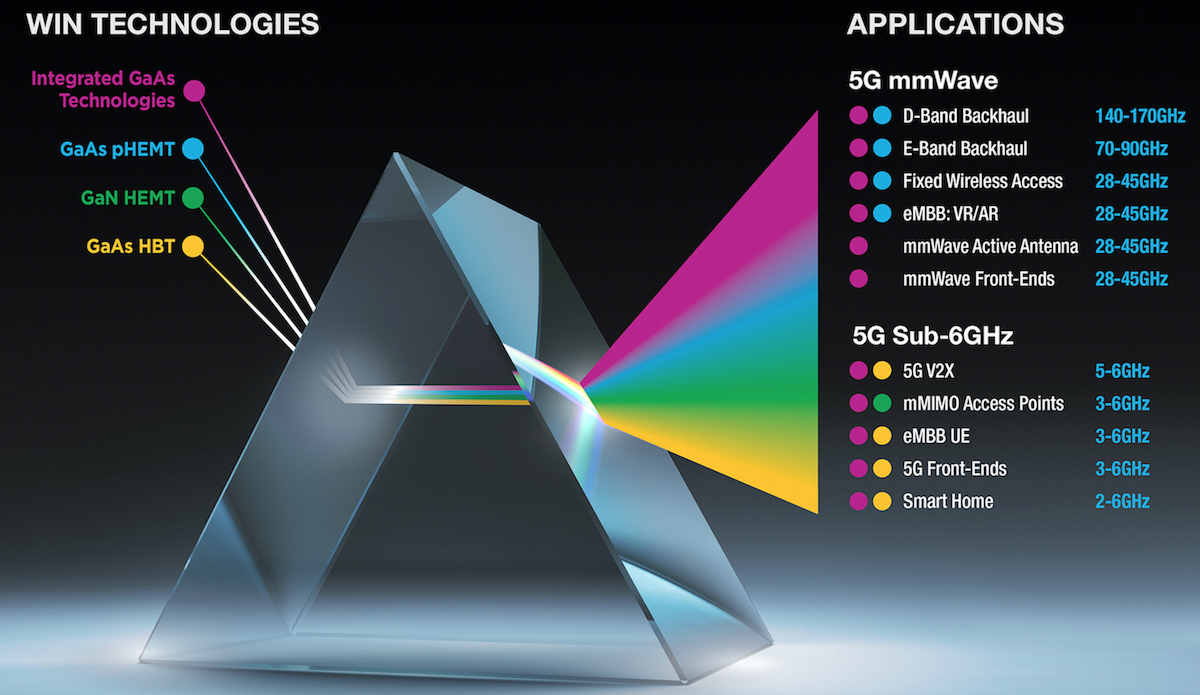
WIN is the first compound semiconductor wafer foundry to commercialize an integrated GaAs platform for producing single chip front-ends
TAOYUAN, Taiwan – WIN Semiconductors Corp has combined an advanced 100GHz ƒt enhancement-mode pHEMT with monolithic PIN and Schottky diodes to provide best-in-class mmWave performance for all front-end functions. The PIH1-10 platform is designed for single chip 5G front ends operating in the 24GHz to 45GHz bands.
The innovative PIH-10 technology provides a new set of integrated GaAs solutions that improve mmWave front end performance. High efficiency Ka-band GaAs power amplifiers, LNAs and low loss switches on a compact single chip front-end will enhance the user experience through improved battery life and better 5G mmWave coverage.
Integrated GaAs front-ends can also be used in mmWave access points, and the higher Tx power and efficiency of PIH1-10 enables smaller active antenna arrays with lower total power consumption than existing RAN hardware.
The core of PIH1-10 is an E-Mode pHEMT that provides the gain, power density and efficiency for mmWave transmit power amplifiers, and the noise performance needed in the receive LNA. This versatile single supply transistor can support Tx power levels of 30dBm and Rx noise figure of 2.5dB at mmWave frequencies. Furthermore, the integrated PIN diode provides excellent mmWave Tx/Rx switch functionality with <1dB insertion loss, enabling monolithic integration of all front-end functions on a single chip.
For more information, visit WIN Semiconductors Corp. at http://www.winfoundry.com/en_US/Index.aspx