Precision cooling for AI electronics
Figure 1: a demonstration of how electrohydrodynamic (EHD) airflow is achieved
From smartphones and laptops to automotive infotainment and smart IoT devices, the direction of travel is consistent: more functionality, more performance, and more intelligence, delivered in smaller and thinner form factors. For design engineers, this creates a familiar but intensifying challenge, and with each new generation comes additional compute, memory, and integration complexity, without a corresponding increase in available space or thermal headroom.
Artificial intelligence has further raised the stakes. Unlike traditional workloads, which tend to be intermittent, AI processing is both compute-intensive and sustained. Modern platforms increasingly run CPU, GPU, and dedicated AI acceleration hardware concurrently, driving higher and more persistent system-level power demands.
As a result, conventional approaches are reaching their practical limits, not only in terms of cooling capacity but in how they constrain system architecture, from board layout to enclosure design. This landscape demands not only a shift in how cooling is considered within the system, from a supporting function to a targeted design element aligned with where heat is generated, but also a shift in the cooling interfaces and architecture themselves.
Why Conventional Cooling Architectures Are No Longer Sufficient
To understand why thermal management is becoming a system-level constraint, it is necessary to understand how conventional cooling architectures are designed to operate.
Across traditional computing devices, thermal design has followed a well-established model. Heat is conducted away from key components such as processors and memory chips using heat spreaders and heatsinks, then removed from the system via fan-driven airflow. These approaches are highly engineered and have evolved significantly, enabling increasingly powerful systems within constrained form factors.
While these conventional cooling architectures target heat-generating components to a degree, they do so indirectly. Heat must first be conducted away from the source and then removed through airflow paths defined at the system level. This introduces inefficiencies and limits how precisely cooling can be applied, particularly in dense layouts where thermally critical components are distributed across the board.
Fan-based systems also impose structural constraints. They require dedicated space, defined airflow channels, and clear intake and exhaust paths, all of which influence board layout and enclosure design. As systems become thinner and more integrated, these requirements can restrict how components are arranged, or even whether they can be included at all. Furthermore, increasing fan size or airflow to compensate is not always viable, introducing trade-offs in power consumption, acoustics, and reliability.
These limitations are becoming more pronounced as system demands continue to increase. AI-driven workloads, in particular, sustain activity across multiple compute elements simultaneously, concentrating heat in specific areas and maintaining higher thermal loads over longer periods. Modern platforms increasingly operate with concurrent CPU, GPU, and NPU activity, pushing sustained system-level power beyond the typical 20 to 50 W range associated with earlier ultrathin designs.
From Bulk Airflow to Zoned Cooling
Today’s limitation is not simply one of cooling capacity, but of alignment. Traditional approaches are not designed to manage sustained, localised heat generation in densely integrated systems. As a result, thermal management is no longer just about removing heat from the system but about controlling where and how that heat is addressed.
A New Approach to Thermal Management
Zoned Cooling design is the solution. Made possible by Ventiva’s ionic cooling technology, Zoned Cooling moves away from bulk airflow and instead delivers localised, targeted airflow directly at the point of need to enable more precise thermal control within increasingly dense and constrained systems.
By removing the need for mechanical fans, these solid-state solutions eliminate noise, with acoustic output below 15 dBA, vibration, and many of the reliability challenges associated with moving parts. More importantly, the compact form factor allows them to be placed in locations that are inaccessible to conventional cooling hardware, opening new possibilities for system layout and integration. The absence of mechanical components also changes the operational profile.
How Ionic Cooling Works
At the core of the ionic cooling approach is electrohydrodynamic (EHD) airflow. Instead of relying on rotating components, Ventiva’s technology generates airflow using an electric field to ionise air molecules and induce motion at a molecular level.
A high-voltage, low-current field is established between two electrodes, a thin emitter and a grounded or low-voltage collector. This field ionises nearby air molecules, creating charged particles within a small ionisation region adjacent to the emitter. These ions are then accelerated toward the collector, entering a drift region where they collide with neutral air molecules.
Through these collisions, momentum is transferred from the ions to the surrounding air, creating a directional flow. The result is a continuous, controlled stream of air generated without mechanical movement.
Because airflow is generated through this ion-driven process, it can be produced in extremely thin form factors, without the need for conventional intake and exhaust pathways. This enables airflow to be created locally at the point of use, rather than distributed across the system, supporting more precise thermal management in compact, high-density electronic designs.
Design Flexibility and System Efficiency
Typical top-in, side-out fan-based systems require an intake volume or plenum above the impeller, consuming valuable Z-height and constraining layout, particularly in thin designs. Ventiva’s ionic cooling modules operate with a side-in, side-out airflow pattern and do not require this intake volume, allowing airflow to be generated within much tighter vertical constraints and closer to the components being cooled.
As a result, devices can be implemented in ultra-thin form factors, in some cases just a few millimetres in height, and mounted in different orientations, with airflow introduced laterally rather than through traditional intake and exhaust paths. This enables cooling to be applied in locations that would otherwise be inaccessible, while reclaiming board space typically reserved for fans and ducting.
Zoned Cooling Architecture and AI Impact
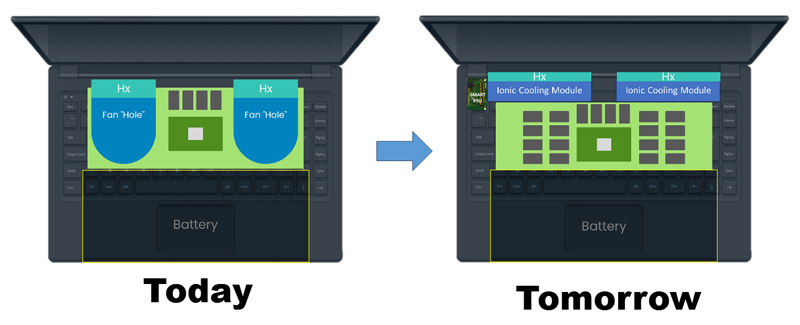
Ventiva’s ionic cooling technology forms a core part of its Zoned Cooling architecture. Rather than treating the system as a single thermal domain, it organises the system into distinct functional zones, such as cooling, compute, and battery regions, allowing cooling to be applied more selectively and efficiently to high-density heat sources such as processors, memory modules, and power delivery components.
Click image to enlarge
Figure 2: Ventiva’s Zoned Cooling architecture approach organises the system into distinct functional zones
This highly localised approach reduces hotspots and allows different parts of the system to operate within their optimal thermal ranges, maintaining performance under continuous workloads such as those driven by AI.
A key advantage of Zoned Cooling design is the ability to separate airflow paths within the system. For example, cooling for the heat exchanger and for user-facing surfaces can be handled independently, allowing each to be optimised without the trade-offs imposed by shared airflow in conventional designs.
This becomes particularly important in the latest generation of designs, where components such as voltage regulators, DIMMs, and interface modules can become thermally constrained despite limited access to system airflow and helps to drive more predictable and efficient performance. Especially, in AI-capable systems, where memory bandwidth and proximity to the processor are critical to overall performance.
By freeing up board space and removing airflow constraints, ionic cooling technology, as part of a Zoned Cooling architecture, enables more memory to be placed closer to the processor, supporting higher bandwidth without increasing system size. In practical terms, this can reclaim up to 7,200 mm² of motherboard area in a laptop, creating space for additional memory, storage, or battery capacity within the same footprint.
Conclusion
Zoned Cooling reflects a fundamental change in the role of thermal management. As system density increases and workloads become more sustained, cooling is a critical parameter that actively shapes system capability. The ability to control where and how heat is addressed allows engineers to make more effective use of available space, optimise component placement, and maintain performance under continuous load.
Ventiva supports this shift by aligning thermal management with the realities of modern system design. The result is that thinner, quieter devices with simplified construction and scalable thermal subsystems become achievable, while maintaining the sustained performance that AI workloads demand.