IR Receivers Deliver Improved Sensitivity, Noise Suppression
New Devices Offer Increased Robustness to Optical and RF Emissions for Remote Control Applications
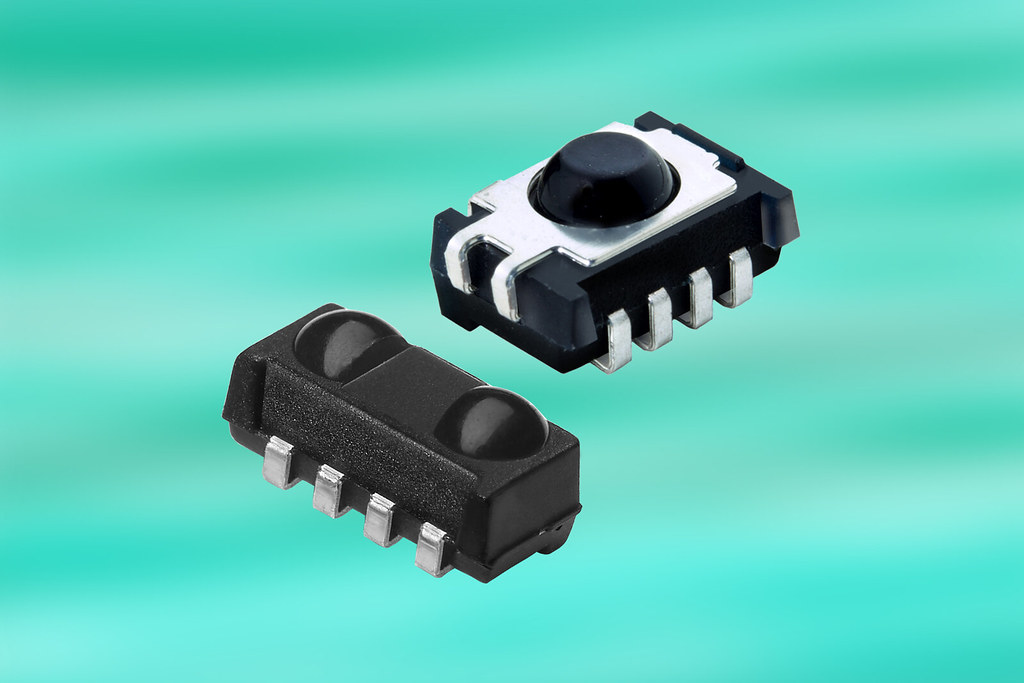
MALVERN, Pa. — Vishay Intertechnology, Inc. introduced two new series of miniature infrared (IR) receiver modules for IR remote control applications. Devices in the Vishay Semiconductors TSOP95xxx and TSOP96xxx series deliver improved dark-ambient and disturbed-ambient sensitivity to infrared signals, better suppression of RF noise, and excellent pulse-width accuracy.
The receivers released today are designed for IR remote control in televisions, set-top boxes (STBs), audio systems, air conditioners, video projectors, cameras, video game systems, and more. For the remote control function in these products, the devices provide increased robustness against disturbances such as IR emissions from CFL lamps and RF emissions from onboard Wi-Fi antennas. In addition, the modules' improved pulse-width accuracy allows lower bit error rates for almost any code, and the devices are insensitive to supply voltage variations and ripple noise.
To simplify designs, the receivers feature a photodetector, preamplifier circuit, and IR filter in a single 4-pin epoxy Heimdall (TSOP95xxx) or Panhead (TSOP96xxx) package. The devices are available with carrier frequencies from 30 kHz to 56 kHz and in five automatic gain control (AGC) versions for short and long burst codes. The receivers feature a low supply voltage from 2.0 V to 3.6 V and a typical supply current of 0.37 mA. They are RoHS-compliant, halogen-free, and Vishay Green.
Vishay can be found on the Internet at www.vishay.com.