Device Provides Drop-In Replacement for Parts From Other Manufacturers, Eliminating the Need for PCB Redesigns
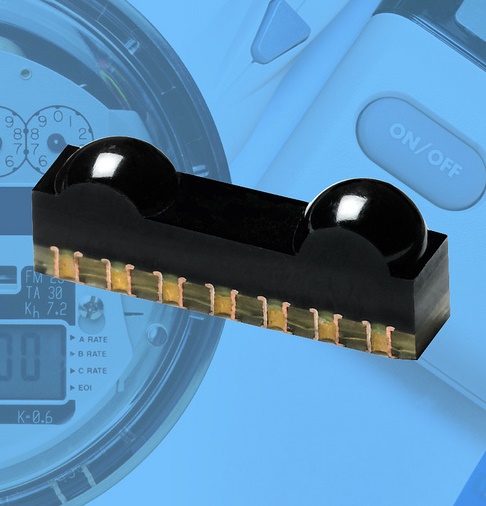
MALVERN, Pa. — Vishay Intertechnology, Inc. announced that the company is providing designers with a new device for IrDA-compliant infrared (IR) transceiver modules in the standard 6.8 mm by 2.8 mm by 1.6 mm footprint. Vishay Semiconductors' TFBR4650 offers a reliable drop-in replacement for devices from other manufacturers. In cases of discontinuation of competitors' parts, this drop-in replacement prevents any need for PCB redesigns.
The device introduced consists of a PIN photodiode, infrared emitter, and control IC in a single package. Compliant with the latest IrDA physical layer standard for IR data communication, the module supports data rates from 9.6 kbit/s to 115.2 kbit/s (SIR) for wireless transmission in gas and power meters, cell phones, microphones, robots, and mobile medical devices.
The TFBR4650 features a link distance up to 30 cm with standard IrDA and up to 20 cm with low power IrDA. The low power specification can be increased to 50 cm using an external resistor to set the emission intensity. Providing low power consumption, the module offers an idle supply current of 75 μA at 3.6 V and a shutdown current of 10 nA typical at +25 °C. Lead (Pb)-free and RoHS-compliant, the device operates from 2.4 to 3.6 V over a temperature range of -25 °C to +85 °C.
Samples and production quantities of the new IR transceiver module are available now, with lead times of eight weeks. Pricing for U.S. delivery only is $ 2.50 per piece.
Vishay