It’s February, which means a new President was just sworn in and Valentines Day and the Super Bowl are right around the corner. It’s Black History month, President’s Day gives the nation’s youth a welcome respite from their studies, and the magical, weather-predicting groundhog may or may not have seen his shadow.
Most importantly, we’re just a month away from the most critical show of the year, the Applied Power Electronics Conference (APEC). For the pomp and pageantry of its 40th anniversary, APEC journeys south of the Mason Dixon Line to the sixth-most populous metropolitan area and birthplace of the Civil Rights Movement in Atlanta, Georgia.
From March 16-20, hundreds of exhibitors and thousands of students, press, marketers, and technologists (last year saw a new record with 6,000 visitors) will explore the confines of the Georgia World Congress Center and its 1.5 million square feet of exhibit space.
This year, in addition to all the normal presentations on power supplies, power conversion, power semiconductors, and all the usual suspects, we’ll also witness the continued evolution of artificial intelligence – no less than 5 Industry Sessions and 1 of 3 Debate (aka, RAP) sessions deal with AI and its future implications.
I expect that nearly every exhibitor I visit will showcase one (or several) AI applications in the same way that wide band-gap semiconductors were the topic du jour for several years (though I expect GaN and SiC will only grow in importance in the coming years).
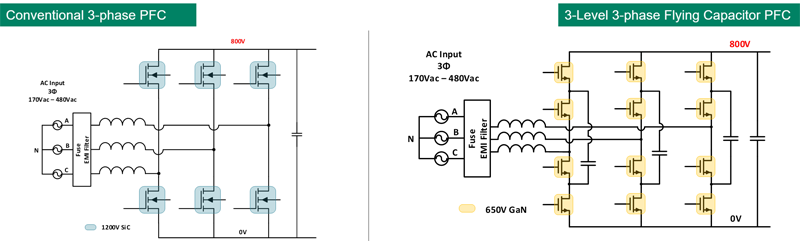
And speaking of which, WBGs are headlining the February issue, and I’d like to highlight one of those articles.
As Efficient Power Conversion’s Adolfo Herrera points out in “Optimizing PCB Thermal Design for GaN FETs: A Guide for Power Electronics Engineers,” power electronic devices dissipate heat either through PCB or the device’s case or backside.
Indeed, “optimizing PCB design parameters like copper layout, thickness, and via configuration is pivotal for effective thermal management.” In so doing, one can maximize heat conduction from the GaN FETs with a minimum of cost or difficulty.
I’d also like to delve into one of our recent PSDcasts, this one dealing with an interesting microreactor application from our old friends at NANO Nuclear Energy (and our longest-tenured PSDcast guest, CEO James Walker).
We’ve covered NANO Nuclear’s microreactor tech before and how it can help advance residential and commercial enterprises, major development projects, and even theoretical applications like helping to send future astronauts beyond low-Earth orbit.
In this case, the microreactor tech would integrate with Vert2Grow’s vertical farming solutions, helping to “address the pressing challenges faced by remote and underserved areas.”
Check it out, and we’ll see you at APEC!
Best Regards,
Jason Lomberg
North American Editor, PSD