KIOXIA Begins Mass Production of Industry’s First QLC UFS Ver. 4.0 Embedded Flash Memory Devices
New 512GB Device Brings the Higher Bit Density of QLC to UFS
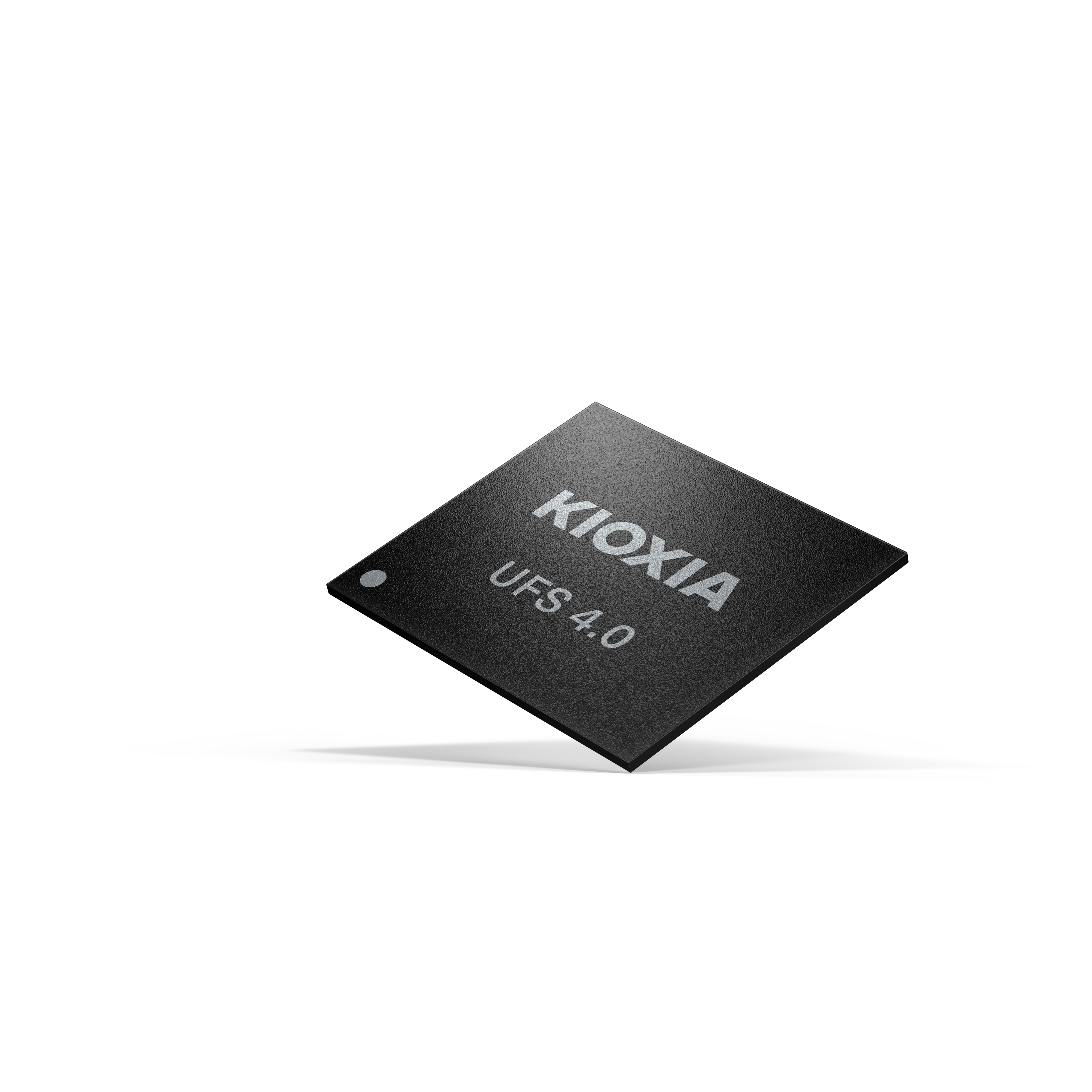
KIOXIA Europe GmbH today announced that it has begun mass production of the industry’s first Universal Flash Storage (UFS) Ver. 4.0 embedded flash memory devices with 4-bit-per-cell, quadruple-level cell (QLC) technology.
QLC UFS offers a higher bit density than traditional TLC UFS, making it ideal for mobile applications that require higher storage capacities. Advancements in controller technology and error correction have enabled QLC technology to achieve this while maintaining competitive performance. KIOXIA’s new 512 gigabyte (GB) QLC UFS achieves sequential read speeds of up to 4,200 megabytes per second (MB/s) and sequential write speeds of up to 3,200 MB/s, taking full advantage of the UFS 4.0 interface speed.
KIOXIA QLC UFS is well-suited for smartphones and tablets, as well as other next-generation applications where higher storage capacity and performance are key considerations - including PCs, networking, AR/VR, IoT, and AI.
Key Features include:
● Supports High Speed Link Startup Sequence (HS-LSS) features: With conventional UFS, Link Startup (M-PHY® and UniPro® initialisation sequence) between device and host is performed at low-speed PWM-G1 (3~9 megabits per second), but with HS-LSS, it can be performed at a faster HS-G1 Rate A (1,248 megabits per second). This is expected to reduce the time for Link Startup by approximately 70% compared to the conventional method.
● Enhances security: By utilising Advanced RPMB (Replay Protected Memory Block) for improved read and write access to security data, such as user credentials on RPMB area, and RPMB Purge to ensure discarded data may be sanitised securely and rapidly.
● Supports Extended Initiator ID (Ext-IID): Intended to be used with Multi Circular Queue (MCQ) at the UFS 4.0 host controller for improved random performance.
KIOXIA was the first to introduce UFS technology, and continues to develop new innovative flash products. The new QLC UFS Ver. 4.0 device integrates the company’s innovative BiCS FLASH 3D flash memory and a controller in a JEDEC standard package. UFS 4.0 incorporates MIPI® M-PHY® 5.0 and UniPro® 2.0 and supports maximum theoretical interface speeds of up to 23.2 gigabits per second (Gbps) per lane or 46.4 Gbps per device. UFS 4.0 is backward compatible with UFS 3.1.
“KIOXIA first sampled 512 gigabyte QLC UFS 3.1 in 2022, and we are very excited to bring the first QLC UFS Ver. 4.0 version to mass production, expanding our UFS Memory product range while showing our commitment to storage technology development and enabling customers to meet growing storage demands,” comments Axel Störmann, Chief Technology Officer & VP at KIOXIA Europe GmbH. “QLC technology delivers higher densities and cost efficiencies, and is, as a result, especially suited for data-intense applications that are demanding superior interface performance.”
For more information, go here.