Large Tin Monosulfide Crystal for Next-Gen Solar Cells
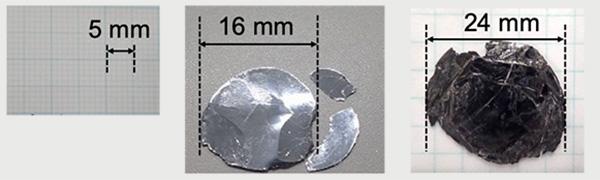
Tin monosulfide (SnS) is a promising material used for next generation solar cells because of its nontoxic characteristics and abundance, in addition to its excellent photovoltaic properties. Sakiko Kawanishi and Issei Suzuki led a team that has succeeded in growing large single crystals of SnS, which can provide a pathway for the fabrication of SnS solar cells with a high conversion efficiency.
A p-n homojunction, which consists of p-type and n-type SnS, is key to obtaining SnS solar cells with high efficiency. The manufacturing of such solar cells has until now proved difficult due to the complexity of fabricating n-type SnS in contrast to the easily fabricable p-type SnS.
To solve the problem, the team designed an original feed composition used for the flux growth of SnS crystals. This is something that had not been successfully trialed before. A dramatic change appeared in the grown crystals by halogen addition, that is, enlargement of the crystal size to a maximum 24 mm in width (Figure 1), in addition to including an n-type conduction characteristic. The larger crystals lower the stakes of trial manufacturing the SnS solar cells with p-n homojunction, which accelerates the development for practical application.
EurekAlert!, the online, global news service operated by AAAS, the science society: https://www.eurekalert.org/pub_releases/2020-08/tu-ltm081920.php