A paper by Kazan Federal University appeared in Plasmonics
A group of researchers led by Professor Myakzyum Salakhov has been working on the problem of optical states in plasmonic-photonic crystals (PPCs). The group mostly consists of young scientists, some of whom started their participation in the project during their student years.
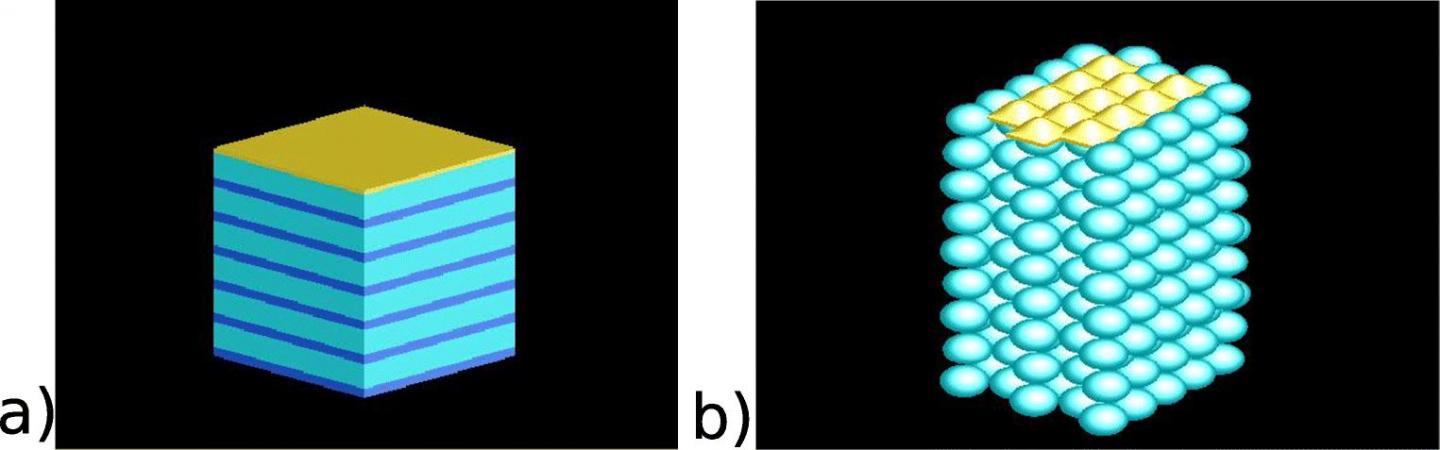
First Category Engineer Artyom Koryukin comments that the research was dedicated to modelling light transmission throughout photonic crystals with a continuous gold layer on their surface. Photonic crystals don't pass a certain wavelength (color) of light. This is called the photonic bandgap - the range of light wavelength where propagation through a crystal is difficult. PPCs, on the contrary, allow the passing of light of a certain wavelength in this photonic bandgap. The problem of three-dimensional opal-like PPCs (OLPPCs), however, is that they don't admit light of certain wavelengths.
In this work, conditions are defined for the passing of a beam of light with the wavelength of the photonic bandgap and certain polarization through an OLPPC. To achieve this goal, different versions of PPCs were modelled. The main conditions to pass such a beam are both the continuity of the gold layer with thickness of about 40 nm and the use of light with polarization. Transmittance of light across a PPC is accompanied by excitations of the optical Tamm states. One- dimensional PPC has a light transmission pass bands inside the photonic bandgap in both polarizations. Three-dimensional PPCs do not have light transmission pass bands inside the photonic bandgap because of a non-continuous gold layer (shaped like separate nano-caps or nano-crescents on the surface of a PPC). So the used OLPPCs have this unique feature - they have a light transmission pass band inside the photonic bandgap with certain polarization due to the excitation of the hybrid mode of the optical states.
OLPPCs with the hybrid mode of the optical states can be used in high-polarization-sensitive sensors. "We assume that the hybrid mode can be useful for improving the control of light in PPCs. New types of resonators based on OLPPCs can be used for the strong interaction of light and matter," adds Mr. Koryukin.
The group is planning to create a theoretical description of the model of such processes. Additionally, they want to find effective applications for OLPPCs, such as strong light-matter interactions with a single photon source.
EurekAlert!, the online, global news service operated by AAAS, the science society: https://www.eurekalert.org/pub_releases/2019-08/kfu-las081219.php