Linear's 2kVAC 9 x 15 x 4.92-mm BGA-packaged 2.5W isolated µModule converter is UL60950 recognized
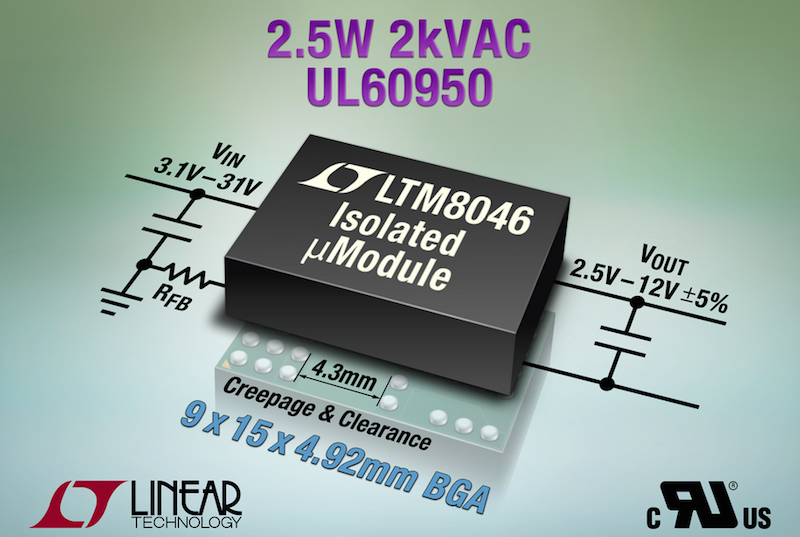
Linear Technology introduced the LTM8046, a 2.5W output DC/DC µModule® (micromodule) converter with 2kVAC galvanic isolation (production tested to 3kVDC) in a 9mm x 15mm x 4.92mm ball grid array (BGA) package. A minimum creepage distance of 4.3mm on the package exterior supports operation at a working voltage up to 400VRMS in a pollution degree 2 environment.* The isolated transformer, control circuitry, power switches, and a modest amount of input and output capacitance are encased in the BGA package. The UL60950 recognized (file# 464570) LTM8046, combined with three 1206 case size or smaller ceramic capacitors and one 0603 size resistor, comprise a highly compact solution for isolated applications such as industrial, transportation and instrumentation equipment.
The isolated µModule converter operates from an input voltage of 3.1V to 31V, delivering a regulated output voltage on the secondary side, adjustable from 1.8V to 12V with ±5% accuracy over temperature. Whether the input voltage is above, below or equal to the desired output voltage, the internal flyback architecture enables the LTM8046 to maintain output voltage regulation. Intelligent thermal design allows the LTM8046 to deliver the full 2.5W output power at ambient temperatures up to 100°C with no forced airflow.
The LTM8046 is available in -40°C to +125°C or -55°C to +125°C internal operating temperature grades for immediate delivery from stock. Pricing starts at $14.47 each for 1,000-piece quantities.
* Pollution degree is a classification reflecting the amount of dry pollution and condensation present in the environment. This classification is important as it affects parameters required to ensure safe operation of the product. Pollution degree 2 refers to an environment where normally only non-conductive pollution or temporary condensation may occur, such as in offices, laboratories and test stations.
.jpg)