Mapping the Energetic Landscape of Solar Cells
Heidelberg University physicists develop new spectroscopic method
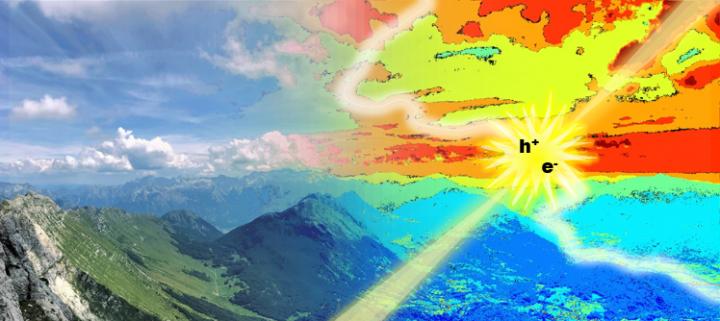
A new spectroscopic method now makes it possible to measure and visualise the energetic landscape inside solar cells based on organic materials. It was developed by a research team led by Prof. Dr Yana Vaynzof, a physicist at Heidelberg University. This novel visualisation technique enables scientists to study the physical principles of organic photovoltaics with extreme precision and to better understand processes such as energetic losses.
"Mapping our Earth's landscapes was a necessary step for understanding the movement patterns and dynamics of people, animals and water, among other examples", explains Prof. Vaynzof, research group leader at the Kirchhoff Institute for Physics at Heidelberg University. "Similarly, the movement of electric charges in a solar cell is determined by the energetic landscape within the device." Until now, visualising these energetic landscapes was so challenging that only rough estimates could be used to study the fundamental processes in organic photovoltaic devices.
The spectroscopic method developed by the Heidelberg researchers can map the energetic landscape on a nanometre scale and can be applied at any point during the solar cell's lifetime. "The strength of our method lies in its excellent resolution and great versatility", says Vincent Lami, member of Prof. Vaynzof's team and the lead author of the study. According to Prof. Vaynzof, their work solves a key problem in the field of organic photovoltaics. "Without mapping the energetic landscapes, it is difficult to understand how and why devices lose energy in the process of converting light into electricity. Now we have a spectroscopic method that allows us to develop new generations of solar cells with reduced energy losses and improved performance", emphasises the scientist, who heads the "Organic Electronics" research group at the Kirchhoff Institute for Physics and works at the Centre for Advanced Materials of Heidelberg University.
EurekAlert!, the online, global news service operated by AAAS, the science society: https://www.eurekalert.org/pub_releases/2019-08/uoh-mte081319.php