Microchip's MOST150 INICs empower automotive smart-antenna modules
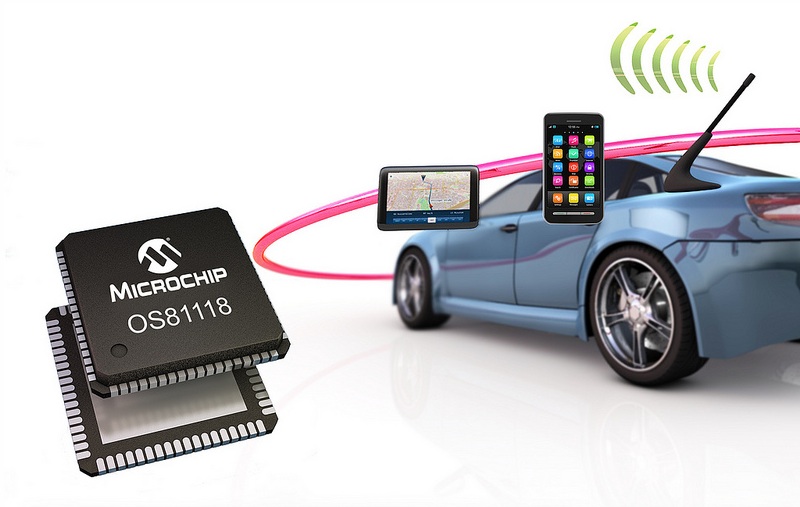
Microchip Technology, a leading provider of microcontroller, mixed-signal, analog and Flash-IP solutions, today announced that the MOST Cooperation released its MOST150 technology coaxial physical layer specification. This new industry-standard specification enables Microchip to support smart antenna module connectivity to in-vehicle MOST150 advanced driver assistance system (ADAS) and infotainment networks, via its OS81118AF Intelligent Network Interface Controller (INIC) with integrated coax transceiver.
The MOST150 coaxial physical layer is ideally suited for smart-antenna telematics and other data traffic from AM/FM, DAB, SDARS, DVB-T, 3G/LTE, GPS and Wi-Fi signals that increasingly need to connect with in-vehicle networks for high-bandwidth control, audio, video and Internet Protocol (IP) communication. Additionally, the ability to utilize the proven and low-cost coaxial cabling to simultaneously deliver communication signals and power to these in-vehicle systems simplifies design and installation efforts while lowering costs and reducing vehicle weight for easier compliance with environmental regulations.
The OS81118AF allows designers to create in-car cellular and Wi-Fi connectivity applications on the MOST150 network by connecting to a smart antenna module via a coaxial cable. This simple solution reflects today’s market demands for wirelessly connected applications within the automotive environment, such as Internet access, e-mail, social networking and location/GPS-based services.
The MOST150 technology was first deployed in the 2012 car models, and the first vehicles with the MOST150 Technology Coaxial Physical Layer are planned for model-year 2017. To date, more than 150 million MOST devices have been installed in over 180 car models since 2001. This cost-effective coaxial implementation of smart antenna modules allows for broad market adoption, and is expected to further expand the use of MOST technology in vehicles.
“We are excited that the MOST Cooperation released its MOST150 Technology Coaxial Specification,” said Dan Termer, vice president of Microchip’s Automotive Information Systems Division. “We are grateful to our customers and the MOST Cooperation working group for joining us in the effort to make this release happen. By employing the MOST150 Technology Coaxial Physical Layer, we are able to offer a technically superior solution with a robust physical layer and proven electromagnetic behavior that allows cost-effective implementations of smart-antenna modules inside vehicles.”
Availability
Microchip’s OS81118AF cPhy INIC is available today for sampling, in a 72-pin QFN package.