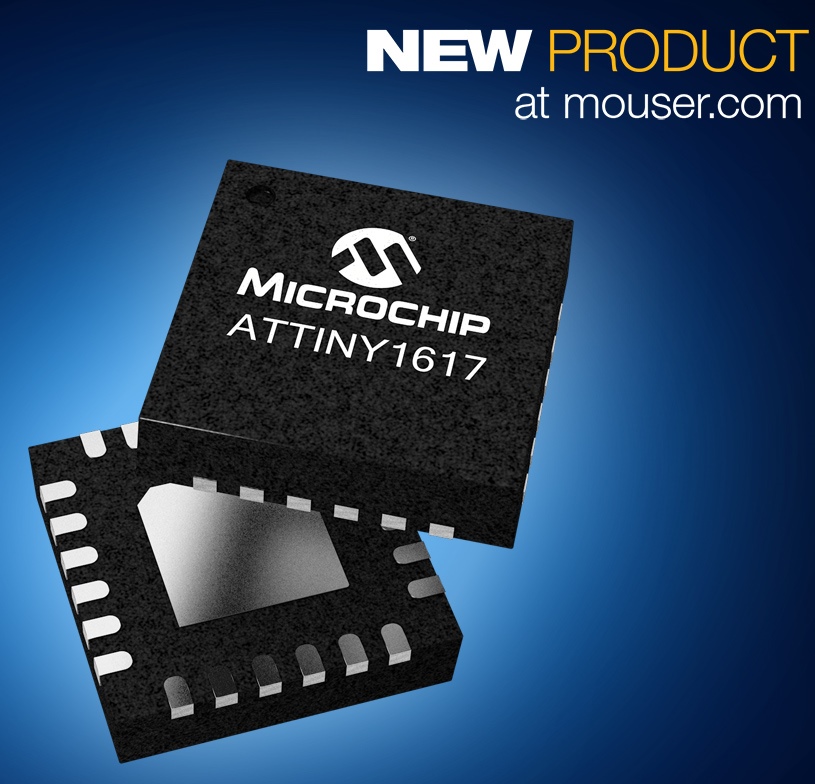
Mouser Electronics, Inc., is now stocking the ATtiny1617 microcontroller series from Microchip Technology. Part of Microchip’s low-power8-bit AVR microcontroller portfolio, the ATtiny1617 devices offer pin and code compatibility with the ATtiny817 series devices while extending the flash memory. The compact 8-bit devices run at up to 20 MHz, and provide a customized configuration and simplified process for capacitive touch systems and Core Independent Peripherals (CIPs) that help increase system throughput while lowering overall power consumption.
The Microchip ATtiny16178-bit AVR microcontrollers, available from Mouser Electronics, feature 16 kBytes of in-system self-programmable flash memory, 256 Bytes of EEPROM, and 2 kBytes of SRAM. Similar to other Microchip tinyAVR microcontrollers, these devices use the 8-bit AVR processor with hardware multiplier and provide an Event System Controller that allows peripherals to communicate without using the central processing unit (CPU). This functionality enables designers to customize the configuration of the microcontrollers to specific applications. Also included on-chip is an integrated QTouch Peripheral Touch Controller (PTC) that helps to simplify the development of capacitive touch systems offering touch interfaces with proximity sensing and a driven shield.
Other integrated features include a 20MHz internal oscillator; high-speed serial communication interfaces that include a USART, SPI and I2C; configurable custom logic blocks; a 10-bit analog-to-digital converter (ADC) with internal voltage references; operating voltages ranging from 1.8 V to 5.5 V; and picoPower technology for sleep currents as low as 100nA.
Combining processing power, analog performance and system-level integration, Microchip’s ATtiny1617 Series microcontrollers are available in a compact 24-pin QFN package and are suitable for a variety of power applications, including LED lighting, motor control, H bridges, and power converters. For development, the devices are fully supported by the Atmel Studio 7 IDE, the STK600 platform, and Atmel’s START online configuration tool.
To learn more, visit http://www.mouser.com/new/atmel/microchip-attiny1617/.