MLCCs Bring Enhanced Performance, Stability and Predictability to Automotive Applications
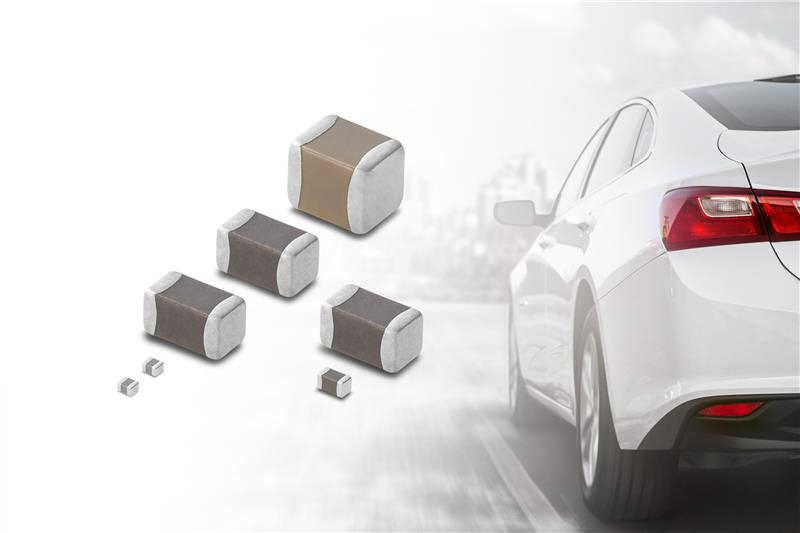
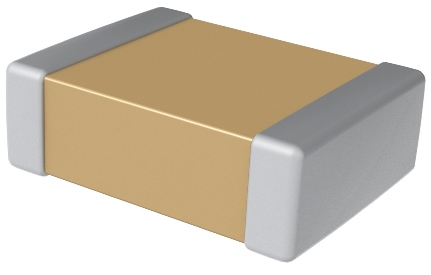
KEMET has announced the extension of its U2J dielectric for automotive grade applications. With AEC-Q200 automotive qualification, the U2J surface mount (SMD) platform offers more than twice the capacitance available in C0G/NP0. It also offers superior temperature performance over X7R, X8R and X5R, rendering it an ideal capacitor solution for vehicle applications.
U2J parts are well-aligned to the stringent demands of automotive systems. Their superior performance versus other technologies can help designers overcome challenges in circuits requiring low-loss, noise reduction, critical timing requirements, and improved capacitance stability versus commonly used X7R-based parts.
Designed for use in environments with operating temperatures ranging from -55°C to +125°C, KEMET’s U2J capacitors only experience small, predictable and linear capacitance changes with respect to temperature. In addition, U2J-based parts retain over 99% of nominal capacitance at full rated voltage, and with low ESR and ESL, can handle very high ripple currents. These new devices are Pb-Free, RoHS and REACH compliant without exemptions.
U2J SMD MLCCs are available now in both commercial and automotive grade and with a flexible termination option. For more information, please visit www.kemet.com/U2J.