Mouser Now Stocking Maxim’s MAX30004 Biopotential Heart Rate Analog Front-End
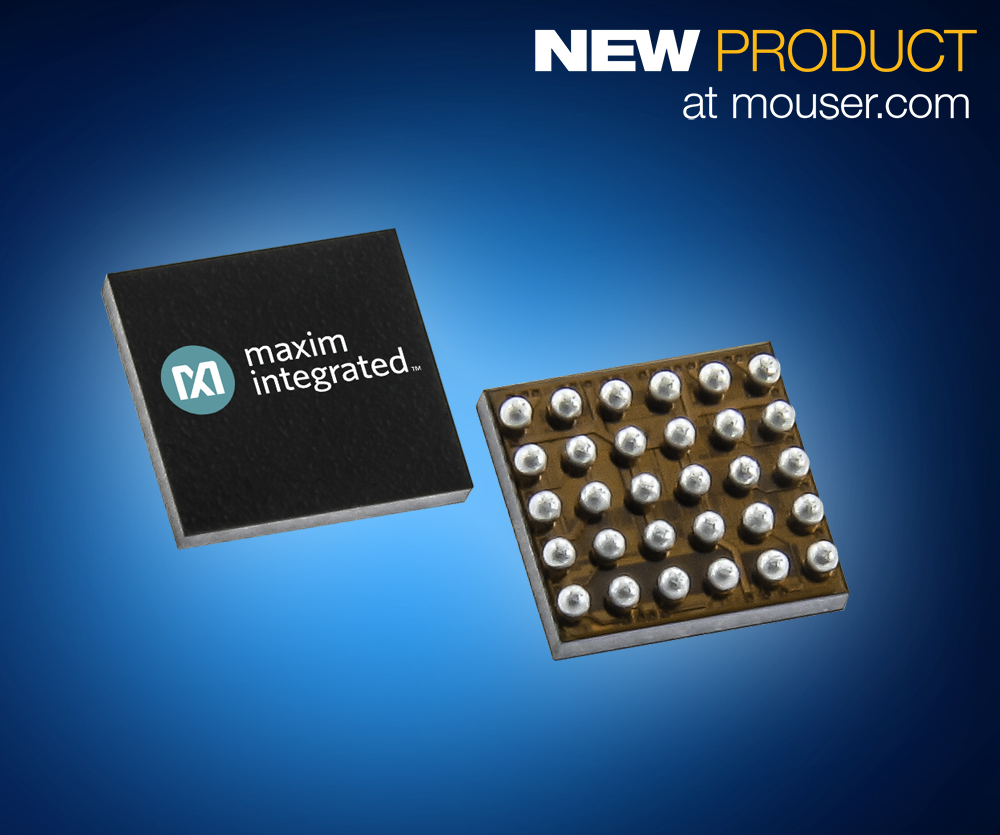
Mouser Electronics, Inc., is now stocking the MAX30004 biopotential analog front-end (AFE) from Maxim Integrated. The MAX30004 AFE is a single-channel biopotential heart-rate detection AFE solution for wearable medical applications, such as chest bands and single-lead wireless patches for heart rate monitoring. The device eliminates the need to extract and process electrocardiogram (ECG) data on its microcontroller for high-motion environments.
The Maxim MAX30004 AFE, available from Mouser Electronics, provides a single biopotential channel that measures R wave-to-R wave interval of heart beats to determine heart rate. The biopotential channel features electrostatic discharge (ESD) protection, electromagnetic interference (EMI) filtering, and DC leads-off detection. The MAX30004 offers extensive calibration voltages for built-in self-testing, and the device’s soft power-up sequencing ensures that no large transient signals are injected into the electrodes.
The device’s fully differential input structure features high common-mode rejection ratio (CMRR) of more than 100 dB and a high impedance of more than 500 MOhms, which results in improved low common-to-differential mode conversion. A 0.7 mA leads-on feature keeps the AFE’s microcontroller in deep sleep mode, with the real-time clock in the off position until a valid lead condition is detected. Configurable interrupts allow the microcontroller to wake up only on every heartbeat, reducing overall system power consumption.
The MAX30004 has a high DC offset range of ±650 mV (1.8 V typical) that allows it to be used with a wide variety of electrodes. The device offers ultra-low power consumption of just 85 mW at a 1.1 V supply, leading to longer battery lifetimes.
For more information, visit http://www.mouser.com/new/maxim-integrated/maxim-max30004-afe/.