Multiphysics software speeds system optimization
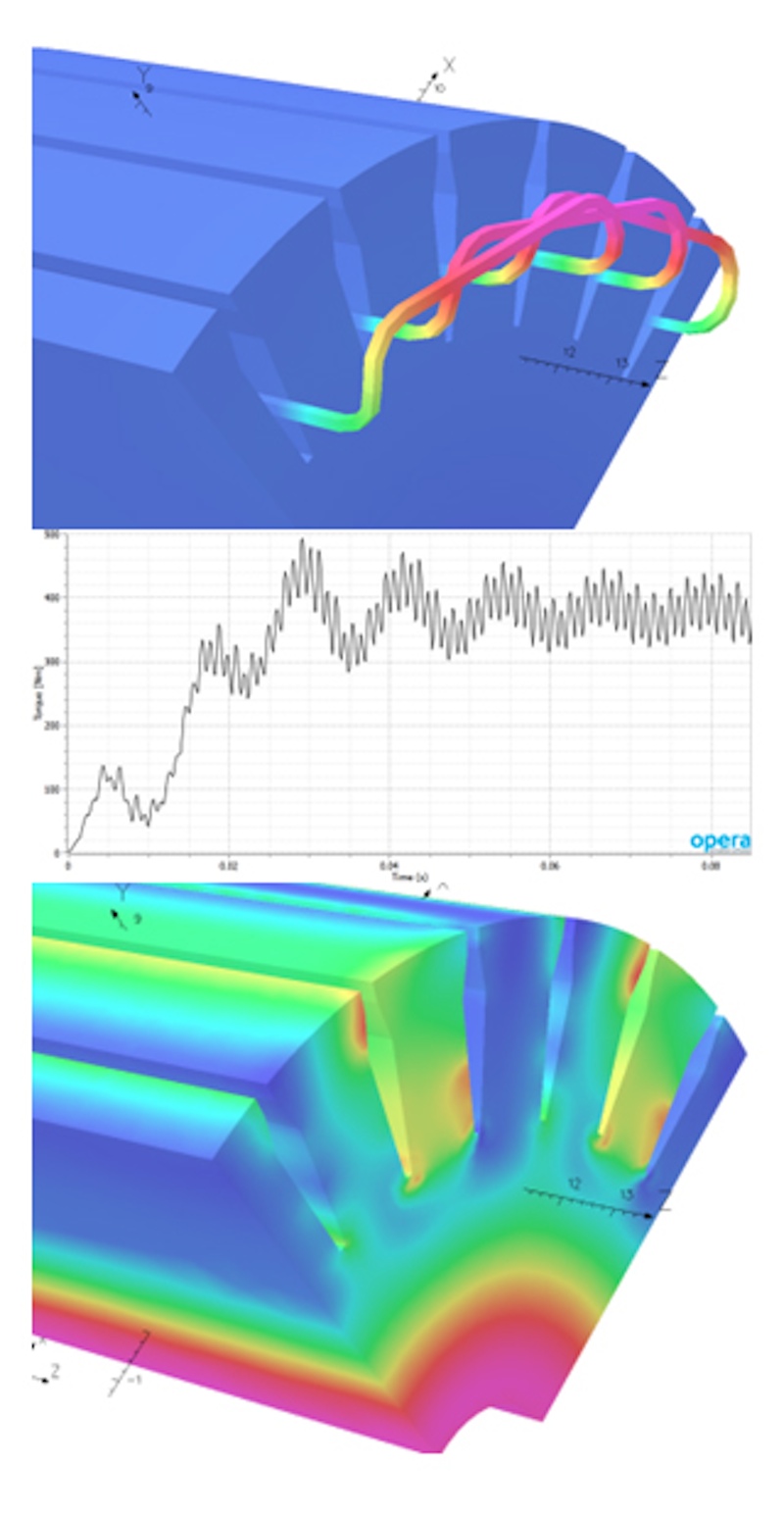
An updated version of the Opera electromagnetic and multiphysics design software has been launched by Cobham Technical Services. The version 18 release of this finite element analysis and simulation software incorporates numerous enhancements to boost functionality, speed and accuracy, while further improving ease of use.
Key features in Opera v18 include a powerful analytic tool to help users quickly assess different winding configurations in rotating electrical machines. A graphical analysis setup tool brings drag-and-drop editing simplicity to complex evaluation sequences involving multiphysics simulation. The modeling of materials with very small skin depths is also made much simpler by a new surface impedance boundary condition for transient electromagnetic analysis; the code for this software is also specifically structured to allow parallel processing to accelerate analysis.
The tool for electrical machine design can shorten development times significantly, by allowing highly detailed investigation of possible winding options prior to finite element analysis and simulation of the most promising designs. Called the Winding Tool, it enables designers to assess the feasibility and efficiency of different coil winding configurations – and their impact on machine performance – very easily and quickly. The software includes a winding wizard, which creates a report of all feasible windings for a user-specified range of slots and poles, backed by detailed winding characteristics for each slot-pole combination. It is available for both the two-dimensional and three-dimensional Opera design software packages.
The Analysis Setup tool simplifies advanced multiphysics simulation significantly, including transient cases. Users can now set up a complete chain of electromagnetic, thermal and stress analysis simulations for example, with no limit on complexity or sequence. Loops are allowed and the results from one simulation are passed automatically to the next. Shape deformation caused by forces acting on a model can be employed across different types of simulation; the deformed mesh from stress analysis can be nominated for use in subsequent electromagnetic or thermal analyses. In the case of coils, the software automatically accommodates any changes in current density values due to shape deformation, facilitating very accurate electromagnetic field analysis.
Another major feature in the latest release of Opera-3d is that the scope of the surface impedance boundary condition (SIBC) has been widened and is now available for use in transient electromagnetic analysis – including Demagnetization and Motional Analysis. The variation of fields and currents below the material’s surface is represented by a decaying waveform, which models the skin depth.
One of the major applications for the new transient SIBC feature is electrical machines. For example, it could be used to improve the accuracy of eddy current and skin effect analysis in conducting parts – to help designers minimize hard-to-combat sources of losses in large rotating electrical machines such as multi-megawatt AC generators.