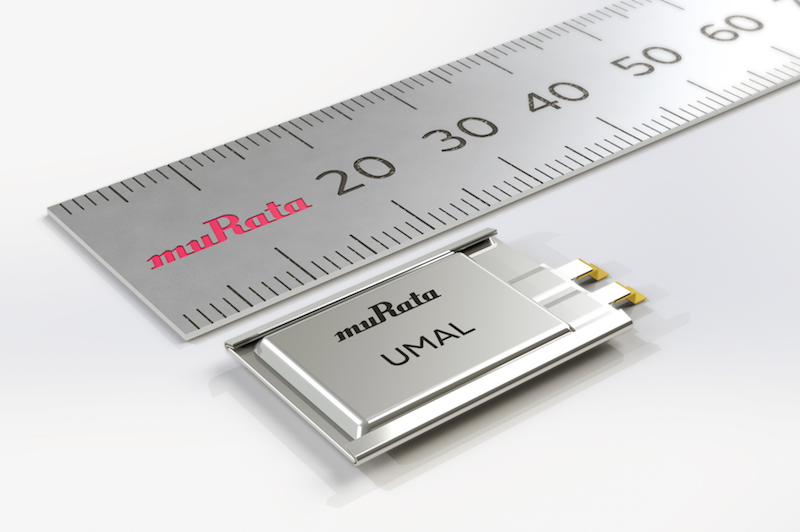
Murata announced the UMAL, a low-profile high capacity energy device. Designed to meet the demand for a slim high capacity energy source with a maintenance-free extended life cycle in wireless sensor nodes, the UMAL has charge/discharge and life-cycle characteristics superior to conventional secondary batteries.
The UMAL has a nominal voltage of 2.3 VDC, can supply 12 mAh with a maximum discharge current of 120 mA and is able to withstand load fluctuations. It has a low internal resistance of 200 mOhm and can operate over the temperature range of – 20 degrees C to + 70 degrees C.
The nominal charge voltage is 2.7 VDC and the UMAL is capable of fast charging / discharge. In particular the device’s high-rate discharge characteristics mean that a peak-assist capacitor is not required. It also has a charge capacity recovery rate of over 90 % after 5,000 charge / discharge cycles. The UMAL measures 2.0 x 14.0 x 21.0 mm.
The device has a chemically stable composition that does not cause a fire or smoke hazard even if the output terminals are shorted out. In addition to wireless sensor nodes, the UMAL is also suitable for use in wearable designs. Mass production will commence in July 2016.