National Semiconductor Ships Industry's First High-Definition Ser/Des with Content Protection for Automotive Infotainment Systems
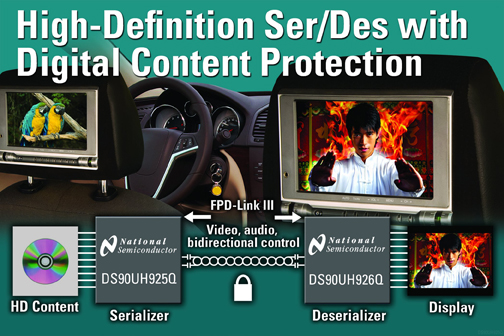
National Semiconductor Corp. introduced the industry's first Ser/Des chipset with high-bandwidth digital content protection (HDCP) for automotive infotainment systems. The FPD-Link III chipset supports in-car distribution of protected video and audio content -- such as Blu-ray movies up to 720p resolution -- to create a home theater experience in the vehicle. National's FPD-Link III Ser/Des chipset consists of the DS90UH925Q serializer and DS90UH926Q deserializer. Both chips carry digital video, audio, and bidirectional I2C control signals concurrently over a single twisted pair cable using the HDCP-protected interface protocol approved by the Digital Content Protection (DCP) LLC (www.digital-cp.com). HDCP is endorsed by major content providers such as Warner Bros., The Walt Disney Company and Sony Pictures Entertainment. Each Ser/Des chipset has a unique HDCP key stored in on-chip memory to protect video content against unauthorized use. National's Ser/Des encrypt the content data and make required authentication exchanges per the HDCP specification. National will demonstrate its Ser/Des at SAE Convergence 2010 in Detroit, Michigan from October 19-20 at Booth #307. The FPD-Link III Ser/Des' on-chip processing of protected content simplifies infotainment system design and eliminates the need for costly secondary components, such as microcontrollers and FPGAs, by handling the computationally intensive tasks of data authentication and encryption. The DS90UH925Q serializer takes data from the head unit processor and converts video, digital I2S audio and control output into a serialized stream of information for distribution through the vehicle's cable harness. The DS90UH926Q deserializer converts the serialized information stream back into video, audio and control outputs needed to drive LCD displays in the central information display and rear passenger seats. The consolidation of video data and control over a single differential pair reduces interconnect size, weight and cost, and further simplifies system design. Both chips serially route 24-bit color video content over distances in excess of 10 meters and provide a wide pixel clock range from 5 MHz to 85 MHz. This enables infotainment system designers to develop a modular platform of video source and display combinations that support an automobile manufacturer's entire vehicle portfolio from luxury to base models. The Ser/Des are AEC-Q100 Grade-2 qualified for operation between -40 degrees C and 105 degrees C, and are powered by a single 3.3V supply. They feature a built-in self test (BIST) mode for factory test, system start up and diagnostics. The FPD-Link III Ser/Des' electromagnetic interference (EMI) performance ensures that infotainment and driver assist high-speed data links can meet rigorous automotive requirements. The DS90UH925Q serializer and DS90UH926Q deserializer are the newest members of National's popular FPD-Link III family for automotive infotainment and driver-assist systems. For more information on National's FPD-Link II and FPD-Link III solutions, visit www.national.com/analog/automotive/infotainment. For more information on National's analog automotive solutions, visit www.national.com/analog/automotive. Pricing and Availability The DS90UH925Q serializer (48-pin LLP®) and DS90UH926Q deserializer (60-pin LLP) chips are sampling now and priced at $11.25 each in 1,000 unit quantities. Production quantities will be available in the second quarter of 2011. For more information, visit: www.national.com/pf/DS/DS90UH925Q.html and www.national.com/pf/DS/DS90UH926Q.html www.national.com