Navitas Powers Xiaomi's First In-Box GaN 100 W Laptop Fast Charger
Next-gen semiconductor drives small size, fast charging for latest Xiaomi Red-miBook Pro laptops
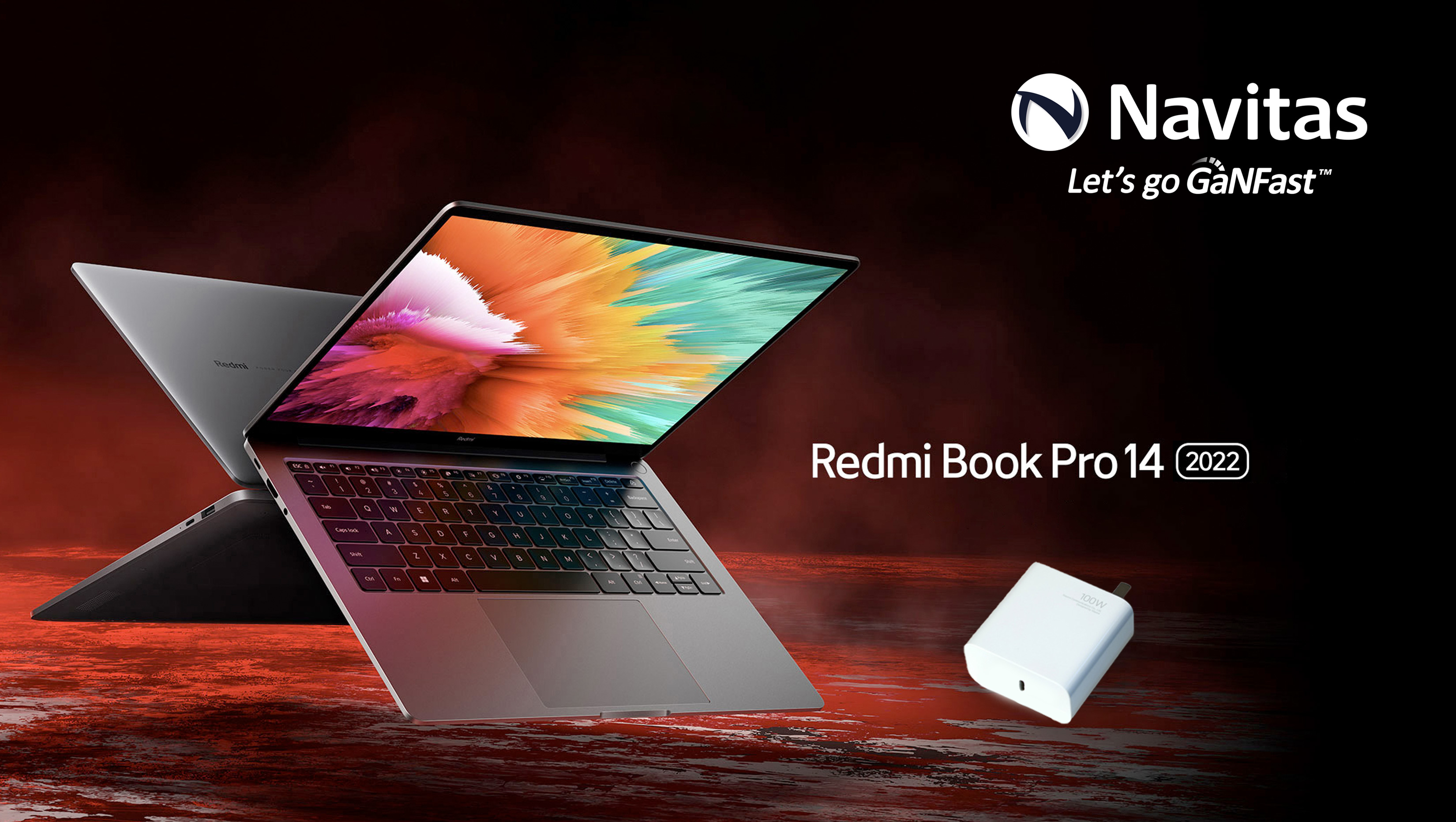
Navitas Semiconductor has announced that the latest Xiaomi Redmi laptop family 100 W fast chargers are driven by next-generation GaNFast power ICs with GaNSense technology.
Consumer electronics giant Xiaomi has adopted GaNFast technology to develop an ultra-compact, high-power-density charger now shipping with all new Xiaomi RedmiBook Pro 14 laptops and the integrated-GPU version of the RedmiBook Pro 15.
The new RedmiBook Pro 14 and RedmiBook Pro 15 lightweight 14” and 15” laptops are built around 12th generation Intel Core i5 and Intel Core i7 mobile processors and are ideal for gamers and other users requiring high-performance, portable computing power. Thanks to Navitas’ GaNFast technology, the ultra-small form-factor 100 W fast charger supplied ‘in-box’ fast-charges from 0-50% in less than 40 minutes.
Measuring only 60 x 58 x 31.6 mm (110 cc), the Xiaomi 100 W achieves a power density of 0.91 W/cc with universal input voltage (90 VAC to 264 VAC) and full USB power-delivery output range (5V/3A, 9V/3A, 15V/3A and 20V/5A) to ensure compatibility with a wide range of other devices, including the latest Xiaomi mobile phones. Two Navitas NV6134A GaN power ICs - with GaNSense technology - are used in the charger’s CrCM boost PFC and HFQR topologies. The loss-less current-sensing function saves costs and improves charging efficiency, and over-temperature protection, over-current protection, and autonomous standby-mode delivers high system reliability for Xiaomi notebook chargers.
For more information, go here.