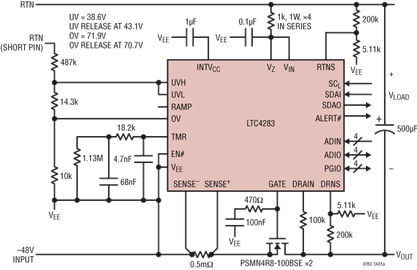
The LTC4283 negative voltage hot swap controller drives an external N-channel MOSFET to allow a board to be safely inserted and removed from a live backplane. The device features programmable current limit with foldback and independently adjustable inrush current to optimize the MOSFET safe operating area (SOA). The SOA timer limits MOSFET temperature rise for reliable protection against overstresses.
An I2C interface and onboard gear-shift ADC allow monitoring of board current, voltage, power, energy, and fault status. An available single-wire broadcast mode simplifies the interface by eliminating two isolators. The included EEPROM provides black-box capturing and nonvolatile configuration of fault behavior.
Additional features respond to input UV/OV, interrupt the host when a fault has occurred, notify when output power is good, detect insertion of a board, turn off the MOSFET if an external supply monitor fails to indicate power good within a timeout period, and auto-reboot after a programmable delay following a host commanded turn-off.
Applications
- Telecom Infrastructure
- –48V Distributed Power Systems
- Servers and Data Centers
- Power Monitors
For more information, visit www.analog.com.