AS8515 sensor interface combines signal processing, voltage regulation, and LIN transceiver in single package
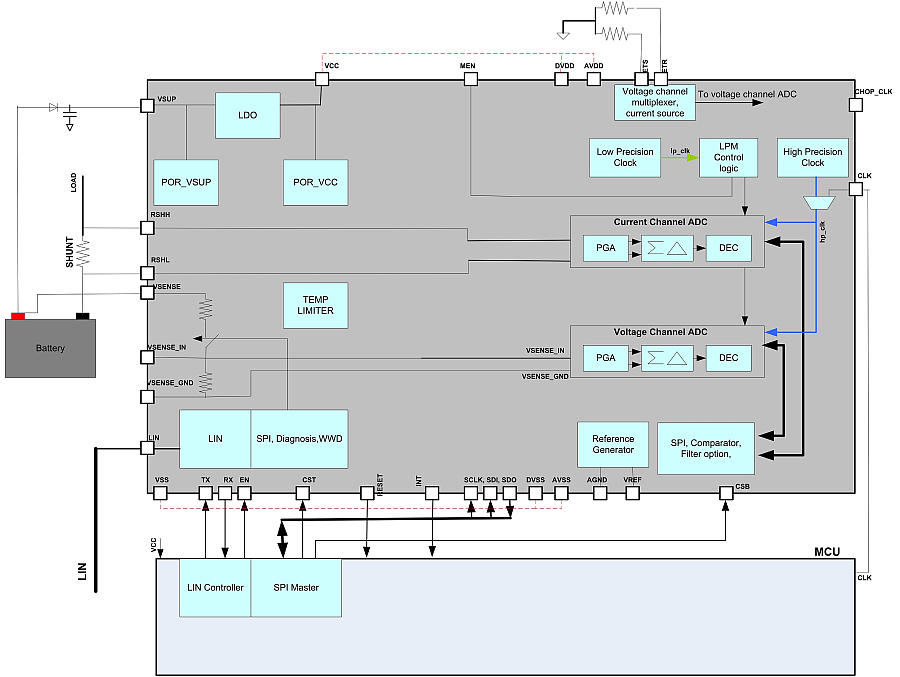
Ams has introduced the AS8515 SiP (system-in-package), which enables implementation of a complete automotive-battery measurement system when interfaced via SPI to any microcontroller. The device is a stacked-die package consisting of a signal-processing die with two high-precision ADC channels for current, voltage, and temperature measurements and a high-voltage CMOS die providing voltage regulation, a LIN transceiver, and watchdog functions. Supporting manufacturers' ISO26262 safety-standard compliance processes, the device is well suited for BMS (battery management systems) for lithium-ion batteries in electric vehicles, hybrid electric vehicles, and vehicles with an internal combustion engine. Providing precise and linear 16-bit digital outputs, the AS8515 is designed for implementing SoC (State of Charge) monitoring in automotive batteries through measurement of open-circuit voltage and coulomb counting. The device also provides extremely accurate and linear conversion of small signals from other devices such as the pressure sensors used in a vehicle's hydraulic, pneumatic, or barometric systems. By integrating voltage regulation and a LIN2.1 transceiver with signal processing circuitry in a single package, the AS8515 provides a complete current and voltage measurement system that only requires the addition of a simple microcontroller and, for current measurement, a precision shunt resistor. The bottom (signal processing) die in the AS8515 is the same die used in the AS8510 sensor interface chip, which ams introduced in January 2011, which provides a high performance current, voltage, and temperature sensor interface. Offering two independent, high-resolution 16-bit ADC channels, it can measure signals from sub-microvolt to 200 mV and measure current across a range from 1 mA to 2000 A through a 100 ?? shunt. All measurements are offset-free and highly linear across the device's specified ambient temperature range of ?40 to 115 °C. System designers can configure the two channels to measure the same input synchronously to provide a redundant design supporting functional safety. The top die in the SiP is an SBC (system basis chip) providing voltage regulation through an LDO, a fully automotive-certified LIN 2.1 transceiver, and various system monitoring and protection features such as power-on reset and a window watchdog function. The AS8515, together with external micro and its I/O ports, offers full flexibility to support use in lithium-ion BMS applications that require multiple interfaces to support functions such as cell balancing. Bernd Gessner, vice-president and general manager of the automotive business unit at ams, said: "The AS8515 offers the right level of integration for automotive battery-system designers, combining power management and LIN communications functions with precise and accurate current and voltage measurements. Offering an ordinary SPI interface, the AS8515 gives designers the freedom and flexibility to choose the MCU they need for their application." The AS8515 integrated sensor interface is available for sampling now. It is priced at $7.50 for 1,000 pieces. A demonstration board for the AS8515 is also available from ams. ams AS8515 product deeplink