A new smart material developed by researchers at the University of Waterloo is activated by both heat and electricity, making it the first ever to respond to two different stimuli.
The unique design paves the way for a wide variety of potential applications, including clothing that warms up while you walk from the car to the office in winter and vehicle bumpers that return to their original shape after a collision.
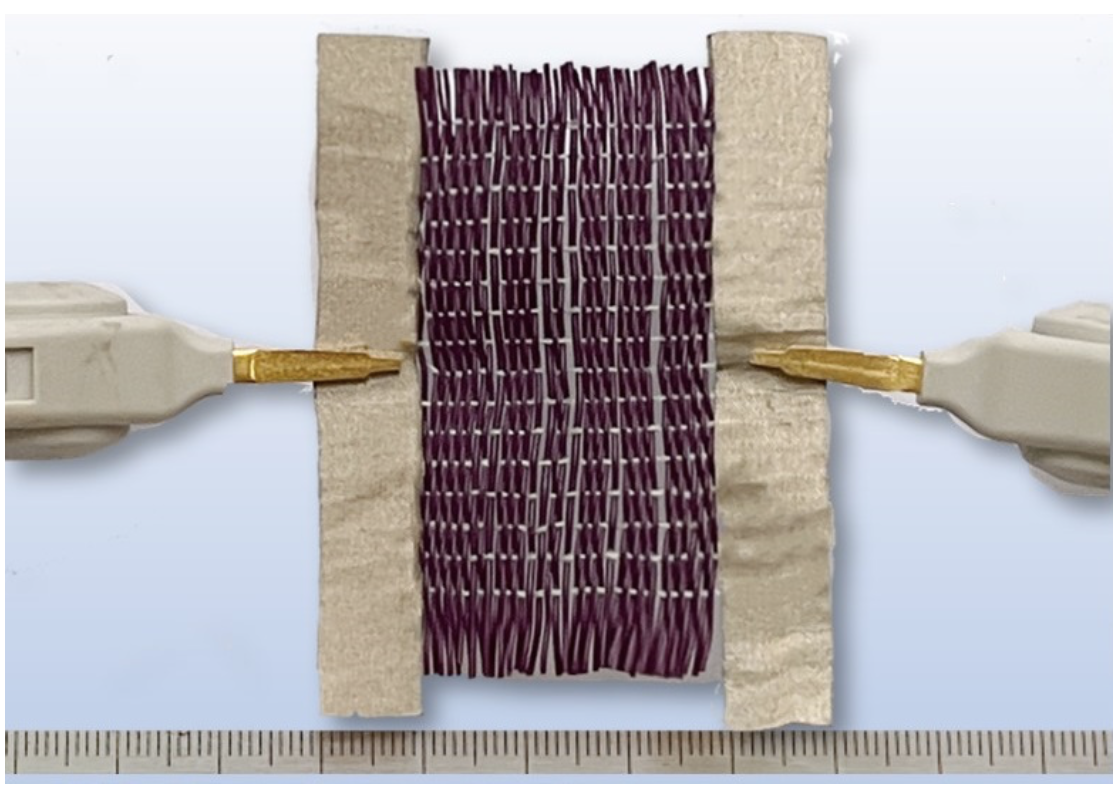
Inexpensively made with polymer nano-composite fibres from recycled plastic, the programmable fabric can change its colour and shape when stimuli are applied.
“As a wearable material alone, it has almost infinite potential in AI, robotics and virtual reality games and experiences,” said Dr. Milad Kamkar, a chemical engineering professor at Waterloo. “Imagine feeling warmth or a physical trigger eliciting a more in-depth adventure in the virtual world.”
The novel fabric design is a product of the happy union of soft and hard materials, featuring a combination of highly engineered polymer composites and stainless steel in a woven structure.
Researchers created a device similar to a traditional loom to weave the smart fabric. The resulting process is extremely versatile, enabling design freedom and macro-scale control of the fabric’s properties.
The fabric can also be activated by a lower voltage of electricity than previous systems, making it more energy-efficient and cost-effective. In addition, lower voltage allows integration into smaller, more portable devices, making it suitable for use in biomedical devices and environment sensors.
“The idea of these intelligent materials was first bred and born from biomimicry science,” said Kamkar, director of the Multi-scale Materials Design (MMD) Centre at Waterloo.
“Through the ability to sense and react to environmental stimuli such as temperature, this is proof of concept that our new material can interact with the environment to monitor ecosystems without damaging them.”
The next step for researchers is to improve the fabric’s shape-memory performance for applications in the field of robotics. The aim is to construct a robot that can effectively carry and transfer weight to complete tasks.