New Tech Builds Ultralow-Loss Integrated Photonic Circuits
Encoding information into light, and transmitting it through optical fibers lies at the core of optical communications. With an incredibly low loss of 0.2 dB/km, optical fibers made from silica have laid the foundations of today's global telecommunication networks and our information society.
Such ultralow optical loss is equally essential for integrated photonics, which enable the synthesis, processing and detection of optical signals using on-chip waveguides. Today, a number of innovative technologies are based on integrated photonics, including semiconductor lasers, modulators, and photodetectors, and are used extensively in data centers, communications, sensing and computing.
Integrated photonic chips are usually made from silicon that is abundant and has good optical properties. But silicon can't do everything we need in integrated photonics, so new material platforms have emerged. One of these is silicon nitride (Si3N4), whose exceptionally low optical loss (orders of magnitude lower than that of silicon), has made it the material of choice for applications for which low loss is critical, such as narrow-linewidth lasers, photonic delay lines, and nonlinear photonics.
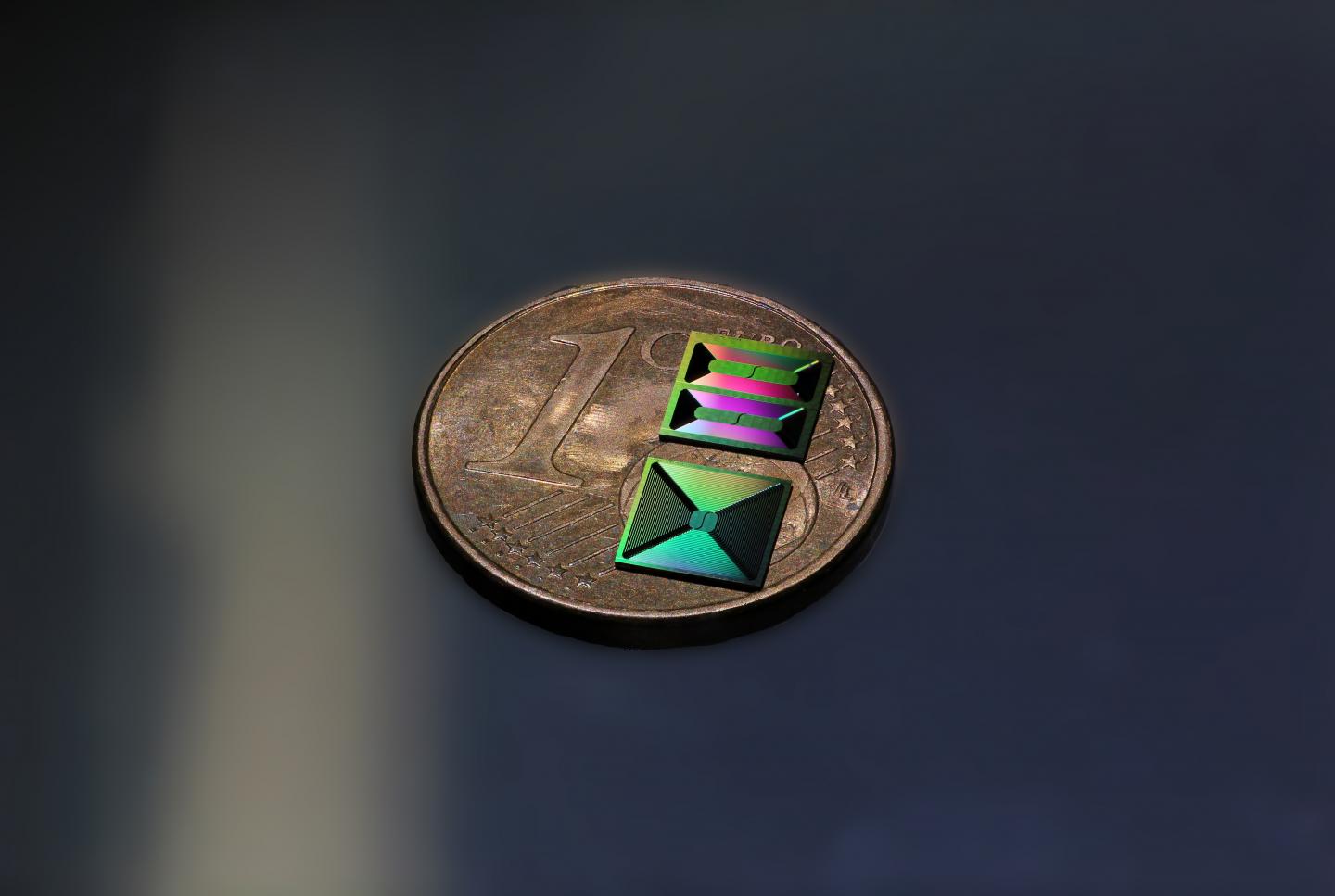
Now, scientists in the group of Professor Tobias J. Kippenberg at EPFL's School of Basic Sciences have developed a new technology for building silicon nitride integrated photonic circuits with record low optical losses and small footprints. The work is published in Nature Communications.
Combining nanofabrication and material science, the technology is based on the photonic Damascene process developed at EPFL. Using this process, the team made integrated circuits of optical losses of only 1 dB/m, a record value for any nonlinear integrated photonic material. Such low loss significantly reduces the power budget for building chip-scale optical frequency combs ("microcombs"), used in applications like coherent optical transceivers, low-noise microwave synthesizers, LiDAR, neuromorphic computing, and even optical atomic clocks. The team used the new technology to develop meter-long waveguides on 5x5 mm2 chips and high-quality-factor microresonators. They also report high fabrication yield, which is essential for scaling up to industrial production.
"These chip devices have already been used for parametric optical amplifiers, narrow-linewidth lasers and chip-scale frequency combs", says Dr. Junqiu Liu who led the fabrication at EPFL's Center of MicroNanoTechnology (CMi). "We are also looking forward to seeing our technology being used for emerging applications such as coherent LiDAR, photonic neural networks, and quantum computing."
EurekAlert!, the online, global news service operated by AAAS, the science society: https://www.eurekalert.org/pub_releases/2021-04/epfd-ntb041421.php