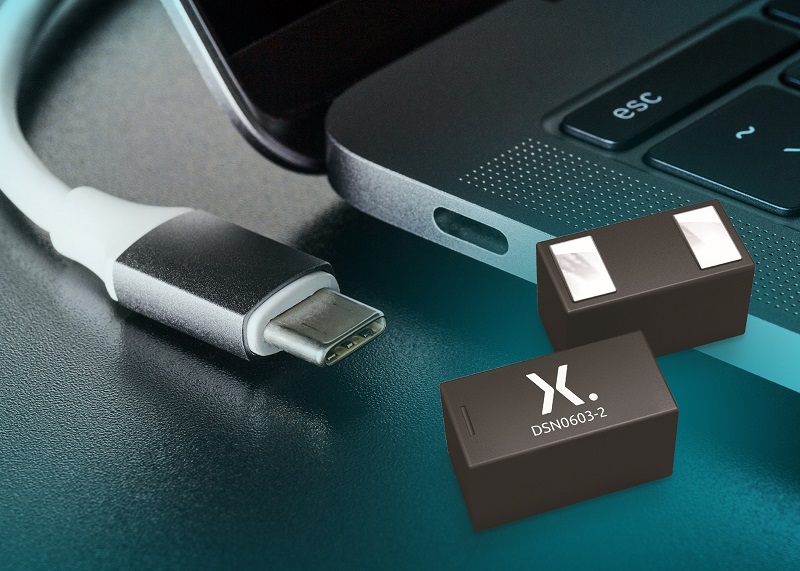
Nexperia today announced the PESD2V8R1BSF, the industry’s first ESD protection device dedicated for the USB4 standard with industry-leading RF performance.
Of special interest to engineers designing USB4 and Thunderbolt interfaces, the new device uses Nexperia’s TrEOS ESD protection technology with active silicon-controlled rectification. It delivers a winning combination of extremely low capacitance (down to 0.1 pF); extremely low clamping (dynamic resistance down to 0.1 Ω) and very high robustness against surge and ESD pulses (up to 20A 8/20 µs for very fast datalines). PESD2V8R1BSF comes in the ultra-low inductance SOD962 package.
Comments Stefan Seider, product manager at Nexperia: “To avoid signal integrity issues, the PESD2V8R1BSF ESD protection diode offers extremely low insertion loss figures of -0.21 dB at 10 GHz and correspondingly low return loss figures of -17.4 dB at 10 GHz. The new ESD protection device is suitable for the higher voltage requirements of USB 3.2. This means it can be placed right behind the USB Type-C® connector to protect the coupling capacitance as well, while still being backwards compatible to USB3.2.”
TrEOS protection diodes are packaged in the very compact, very robust DSN0603-2 (SOD962) package. The advantages of this widely-used 0603 form factor are lowest inductance for fastest protection and a reduction of mechanical and thermal stress, because bond-wires are replaced by integration into the monolithic circuit.
More information on the new ESD protection device PESD2V8R1BSF including product specifications and datasheet is available at www.nexperia.com/USB4protection