Nichia and Infineon Launch Industry's First High-Definition Micro-LED Matrix Solution
Automotive LED lighting technology has developed rapidly in recent years as a means for vehicle manufacturers to enhance driving comfort and road safety. In this regard, matrix LED technology for adaptive driving beam has become an important headlight feature for selective road illumination.
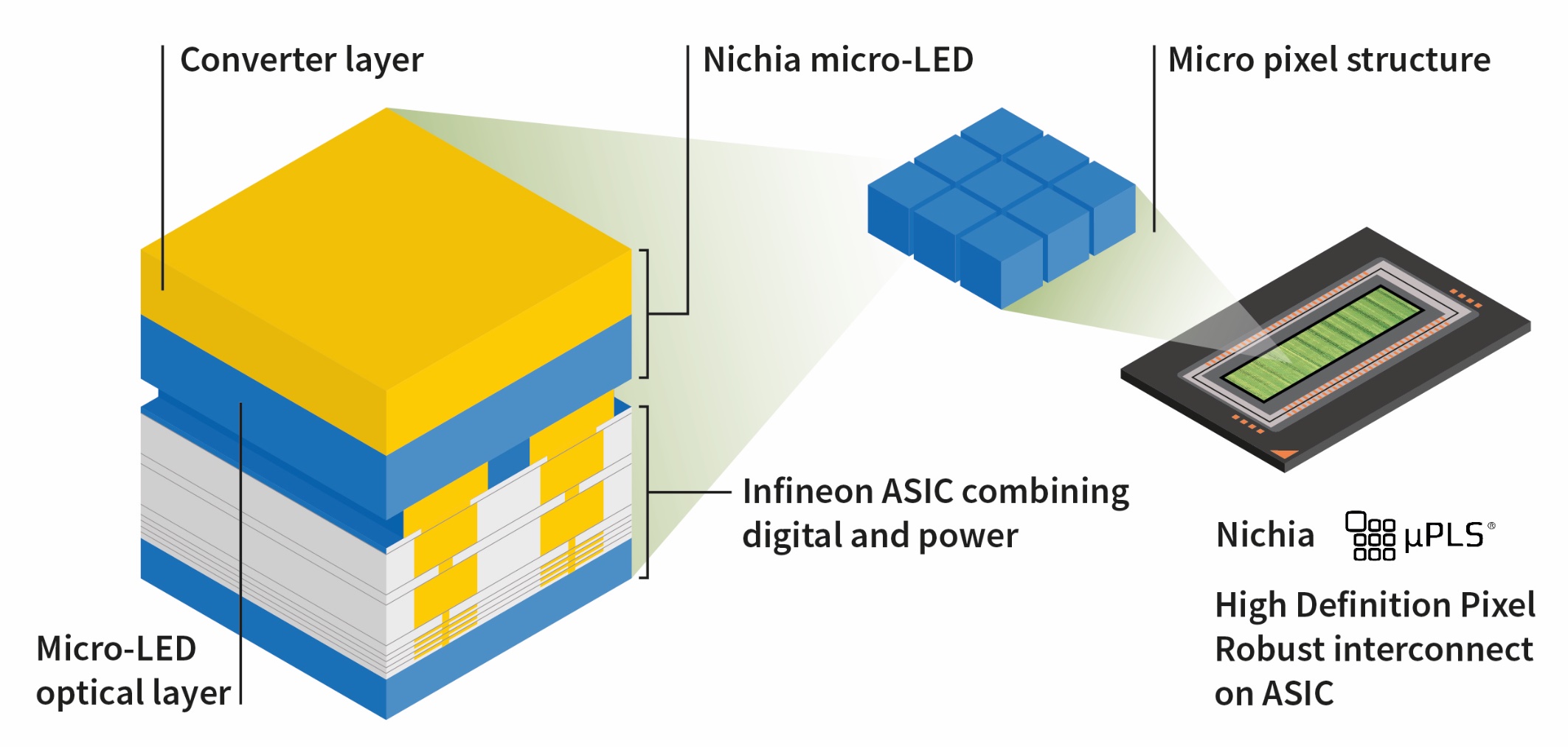
Three years ago Nichia Corporation and Infineon Technologies AG announced the joint development of a high-definition (HD) light engine with more than 16,000 micro-LEDs for headlight applications. Now, both companies are launching industry’s first fully integrated micro-LED light engine for HD adaptive driving beam applications. The micro-LED matrix solution will be seen in a German premium vehicle in 2023.
“The new 16,384 pixel µPLS™ micro-Pixelated Light Solution is our latest addition to Nichia’s portfolio of high-class automotive lighting solutions,” said Yusuke Yamazaki, Head of Sales and Marketing Automotive, Nichia Europe GmbH. “It combines high-definition resolution with industry’s highest light output. This solution enables a new automotive lighting experience by providing four-times wider field-of-view with significantly higher light output than any other current micro-mirror based HD matrix-light solution. For this reason, the advanced HD light can warn drivers of hazards by highlighting people or objects on or by the side of the road. It can also project markings on the road to guide the driver through a construction site or intersection. In addition, functions such as the glare-free high beam or bending light work more precisely and smoothly compared to current adaptive driving beam solutions. This takes the driver’s road safety and driving comfort to a new level.”
“The µPLS is industry’s first fully integrated matrix LED driver capable of driving 16,384 LEDs, combining all required micro-LED driver circuitry with extensive diagnostics and high-speed video and control interfaces,” said Andreas Doll, Infineon’s Senior Vice-President and General Manager of the Business Unit Body Power of Infineon’s Automotive Division. “Our innovative µPLS is much more energy efficient than current HD matrix lighting solutions, contributing to saving global CO 2 emissions and extending the range of electric driven vehicles. Furthermore, we enable the vision of our customers to deploy fully digital light on the road, saving them overall system cost at a very small form factor at the size of a single semiconductor chip. The µPLS is another great example of how Infineon products support digitalization as well as decarbonization towards a net-zero society.”
The new HD light engine uses Nichia's micro-LED technology and an integrated LED driver IC from Infineon that can drive all 16,384 micro-LEDs individually using pulse-width modulation (PWM) control. Additionally, the driver IC monitors each micro-LED separately and provides on-chip temperature monitoring allowing for optimal thermal control. Integrated video interfaces enable high-speed transmission of the video signal from the light pattern generator unit. Unlike current HD matrix solutions, Infineon’s driver IC only activates the LEDs that are actually needed for a light pattern. This dramatically increases the energy efficiency of the µPLS light engine at much smaller form factor compared to micro-mirror-based HD matrix solutions in the market.
This allows for smaller and slimmer headlamp designs in the future. In addition, the new HD light engine enables adjustments that can be digitally programmed at the factory or activated by the vehicle manufacturer or driver on demand. For example, the different requirements of left- and right-handed drivers can be considered, significantly increasing user-friendliness. With all these features, the new HD light significantly reduces design and production complexity for vehicle manufacturers.
More information on Infineon’s commitment to New Mobility.