Novel Current-Sharing, Diode-OR Controller Eases Design of Reliable Power Systems
Current-Sharing IC Enhances System Reliability
without Trimming Supplies
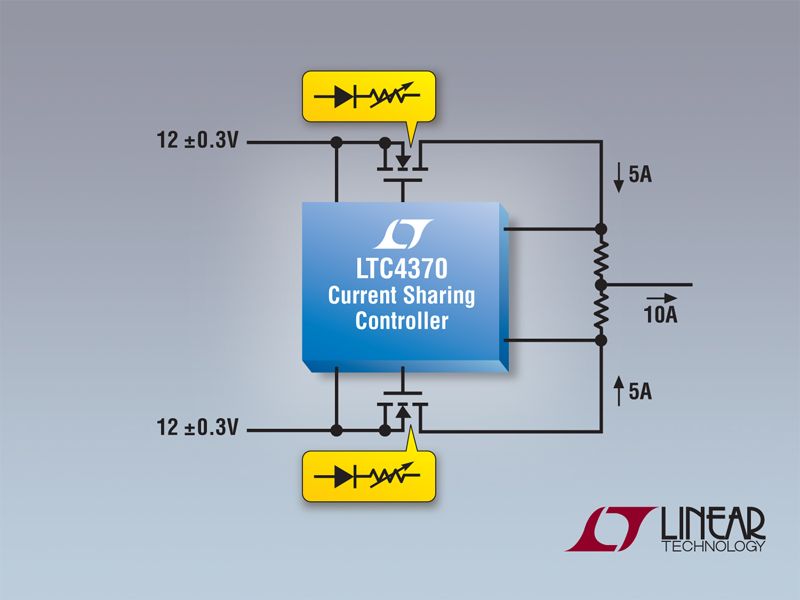
Linear Technology Corporation introduces the LTC4370, a first-of-its-kind current-sharing controller with reverse current blocking. The LTC4370 frees the designer from the limitations and complications of existing current-sharing methods to obtain a simpler, quicker, and space-saving solution for sharing between two supplies. Its supply-agnostic feature lends the design more flexibility and a longer lifetime. By incorporating diode behavior, the controller prevents one supply failure from bringing down the entire system. Designers of high availability systems frequently engineer redundancy into their power systems by paralleling two similar supplies with diodes (diode-OR) such that one can handle the load when the other fails. System reliability is further increased if both supplies operate simultaneously, each sharing half the load current. Lower currents lead to cooler operation, reducing the failure rate by half for every 10°C fall in temperature. Other load-sharing benefits include faster recovery after supply failure, and the ability to operate supplies near their peak efficiency point. Prior to the LTC4370, load-sharing solutions demanded active control of the supplies through their trim pins or feedback networks. They also required a share bus, and stability compensation dependent on the supply type. The LTC4370 greatly simplifies designs of reliable power systems. The LTC4370 controls N-channel MOSFETs in series with each supply. These MOSFETs act like diodes with a variable forward voltage. The LTC4370 adjusts the forward voltage of the MOSFET diodes to offset the mismatch in input supply voltages until the currents from each supply are equal. To limit MOSFET power dissipation, the maximum voltage drop across the MOSFET is adjustable with an external resistor. The controller operates with supplies in the range of 0V to 18V. During faults, a fast MOSFET turn-on and turn-off limits the load voltage droop and shoot-through currents between supplies. Enable pins can turn each MOSFET off; when both are off, the controller bias current is lowered. Status pins indicate the MOSFET on state, which can be used to signal a break in current sharing by lighting a red LED. The load sharing feature can also be switched off to turn the device into a dual ideal-diode controller. Specified over the full commercial and industrial temperature ranges, the LTC4370 is offered in 16-pin DFN (4mm x 3mm) and MSOP packages. Pricing begins at $4.95 each for 1,000-piece quantities and the device is available today in production quantities. Evaluation circuit boards are available online or from your local sales office. For more information, visit www.linear.com/product/LTC4370. Summary of Features: LTC4370 Load Shares Two Supplies
- Eliminates Need for Active Control of Input Supplies
- No Share Bus
- Blocks Reverse Current
- No Shoot-Through Current During Startup or Faults
- 0V to 18V Operation
- Enable Inputs
- MOSFET On Status Outputs
- Dual Ideal Diode Mode
- 16-Pin DFN (4mm x 3mm) & MSOP Packages