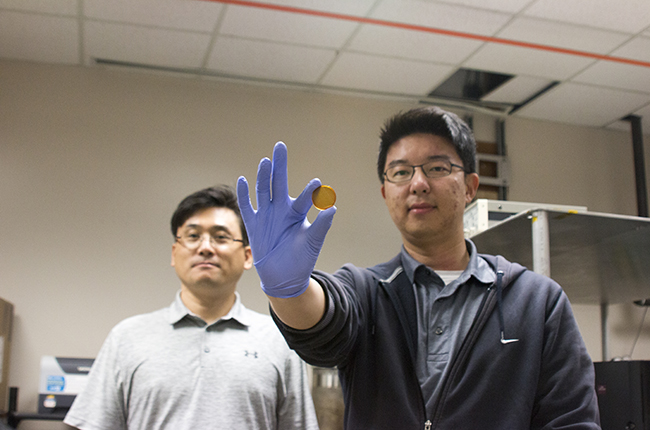
Dr. Choongho Yu, Gulf Oil/Thomas A. Dietz Career Development Professor II in the Department of Mechanical Engineering at Texas A&M University, and his graduate student group has developed a new concept of electrical energy storage: Thermally Chargeable Solid-state Supercapacitor.
This innovative supercapacitor allows charging to be completed using thermal energy in addition to the traditional electrical charging method for capacitors.
“This is the first time that it has been discovered that a solid-state polymer electrolyte can produce large thermally induced voltage,” Yu said. “The voltage can then be used to initiate an electrochemical reaction in electrodes for charging.”
The Thermally Chargeable Solid-state Supercapacitor works by converting thermal energy into electrical energy and then storing it in the device at the same time. For example, human body heat, or any heat dissipating objects that create temperature differences from their surroundings can be used to charge the capacitor without external electrical power sources.
The supercapacitor is also flexible in that it can be used as a power supply for wearable electronics, and can be integrated into wireless data transmission systems to operate IoT (internet of things) sensors. IoT is a concept of connecting various electronic devices and sensors for data communication and exchange, which is particularly useful in real-time monitoring.
Yu and his Ph.D. student, Suk Lae Kim, used a physical phenomenon known as the Soret effect — using a solid-state polymer electrolyte, in which a temperature gradient along the supercapacitor moves the ions from the hot side to the cold side — generating high thermally induced voltage.
“This thermally self-chargeable flexible supercapacitor powered by thermally diffused ions holds great potential to power electronic devices in a whole new way — without the traditional external power supply or battery replacement,” Yu said.