NRL achieves highest open-circuit voltage for quantum dot solar cells
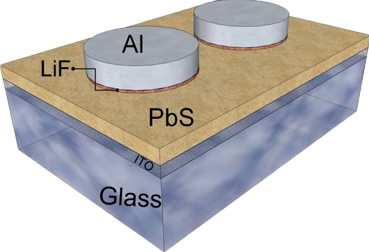
U.S. Naval Research Laboratory (NRL) research scientists and engineers in the Electronics Science and Technology Division have demonstrated the highest recorded open-circuit voltages for quantum dot solar cells to date. Using colloidal lead sulfide (PbS) nanocrystal quantum dot (QD) substances, researchers achieved an open-circuit voltage (VOC) of 692 millivolts (mV) using the QD bandgap of a 1.4 electron volt (eV) in QD solar cell under one-sun illumination. "These results clearly demonstrate that there is a tremendous opportunity for improvement of open-circuit voltages greater than one volt by using smaller QDs in QD solar cells," said Woojun Yoon, Ph.D., NRC postdoctoral researcher, NRL Solid State Devices Branch. "Solution processability coupled with the potential for multiple exciton generation processes make nanocrystal quantum dots promising candidates for third generation low-cost and high-efficiency photovoltaics." Despite this remarkable potential for high photocurrent generation, the achievable open-circuit voltage is fundamentally limited due to non-radiative recombination processes in QD solar cells. To overcome this boundary, NRL researchers have reengineered molecular passivation in metal-QD Schottky junction (unidirectional metal to semiconductor junction) solar cells capable of achieving the highest open-circuit voltages ever reported for colloidal QD based solar cells. Experimental results demonstrate that by improving the passivation of the PbS QD surface through tailored annealing of QD and metal-QD interface using lithium fluoride (LiF) passivation with an optimized LiF thickness. This proves critical for reducing dark current densities by passivating localized traps in the PbS QD surface and metal-QD interface close to the junction, therefore minimizing non-radiative recombination processes in the cells. Over the last decade, Department of Defense (DoD) analyses and the department's recent FY12 Strategic Sustainability Performance Plan, has cited the military's fossil fuel dependence as a strategic risk and identified renewable energy and energy efficiency investments as key mitigation measures. Research at NRL is committed to supporting the goals and mission of the DoD by providing basic and applied research toward mission-ready renewable and sustainable energy technologies that include hybrid fuels and fuel cells, photovoltaics, and carbon-neutral biological microorganisms. U.S. Naval Research Laboratory