On Semi's new dev kits enable engineers to accelerate Cloud-based IoT
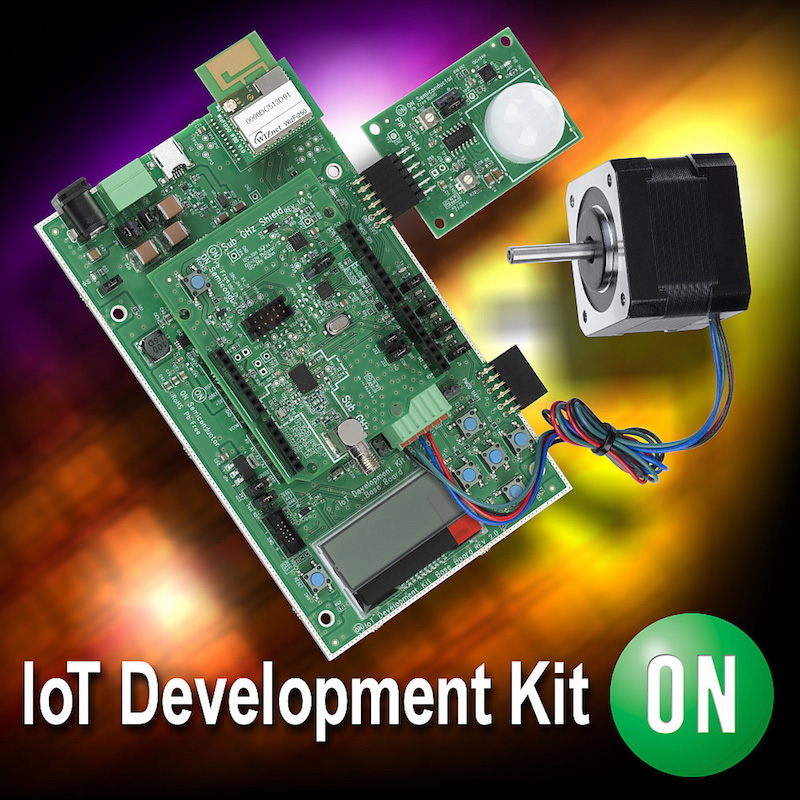
ON Semiconductor, driving energy efficient innovations, continues to lead the progression of Internet of Things (IoT) technology with the evolution of its game-changing IoT Development Kit (IDK). Encompassing both hardware and software elements, this multi-faceted product, with a unique modular construction, presents a configurable platform that enables engineers to evaluate, develop and release to market highly differentiated IoT systems in the shortest possible timeframes. The inherent flexibility of the IDK means that it has the necessary scope to address a broad spectrum of industry sectors - including environmental monitoring, healthcare, home/building automation, industrial control and wearable electronics.
The IDK’s baseboard features the company’s advanced NCS36510 system-on-chip (SoC), with a low power-optimized 32-bit ARM Cortex-M3 core, running the ARM mbedTM OS. By attaching different daughter boards to the Wi-Fi enabled IDK baseboard, a wealth of connectivity protocols enabled by the company’s ultra-low power radios (SIGFOX, Thread, EnOcean, Wireless Mbus, Bluetooth® Low Energy, ZigBee, PoE, CAN, etc.), sensors (temperature, moisture, ambient light, proximity and pressure, along with heart rate monitoring and bio sensor interfaces) and actuators (with stepper and brushless motor driving, plus the ability to drive LED strings) can be added to the system. In addition, the portfolio includes support for numerous functions important for implementing security, including encryption, secure debug, secure boot and authentication.
This is complemented on the software side by an Eclipse-based integrated development environment (IDE) that includes a C++ compiler, debugger and code editor. A comprehensive set of application examples, use cases and related libraries have also been incorporated into the package, in order to more facilitate the process of taking IoT designs from the initial concept phase through to full scale deployment. In addition to the default cloud software platform, support for industry standard Cloud connectivity protocols (MQTT and REST) allows utilization of other widely used IoT cloud service providers.
“So far semiconductor vendors have not adequately seized on the total range of opportunities the IoT embodies, offering just single board solutions that have fixed connectivity and sensor options. This simply isn’t enough. What is needed is a far less restricted, completely modular approach,” states Wiren Perera, who spearheads IoT Strategy at ON Semiconductor. “Having sampled the IDK to some of our key customers, the feedback we’ve received has been phenomenal, with everyone recognizing the value in what has been created here. It not only underlines the strength of our product portfolio, but also our unique ability to integrate various technologies together to create more effective, simple to implement solutions that combine sensing, communication, actuation, power management and processing.”
“Facilitating extensive configurability in out-of-the-box prototyping requires a broad portfolio of sensors, connectivity and actuators,” said Michael Horne, deputy general manager and vice president of marketing and sales, IoT Business, ARM. “ON Semiconductor’s IoT Development Kit (IDK) utilizes ARM mbed OS and simplifies the complexities of IoT development, enabling customers to focus on key IoT solution differentiators.”
Availability
The IDK product recommendation tool provides a convenient, step-by-step process to select the correct configuration for your design and to place an order. Available daughter boards include SIGFOX, PoE, and CAN connectivity; motion, ambient light, and touch pad sensing; and stepper motor, BLDC motor and dual LED driver actuation. EnOcean, Thread and Wireless Mbus support is planned to be available in Q2, 2017, with BLE planned to follow in Q3, 2017. Unique temperature, moisture, proximity and pressure sensing devices are also planned to be available in Q2.
 Single.jpeg)


