Automating Industry 4.0 is pushing the industry forward
Industry 4.0, the latest industrial revolution, is changing the way manufacturing organizations think about production. The aim of Industry 4.0 is to make manufacturing more flexible and responsive to customer needs, providing the ability to make small batches that are tailored to individual customers.
The quantity may be as little as one. But these tiny batches need to be made as efficiently as if one customer had placed a bulk order for a single type of product. This requirement has a fundamental impact on automation within the factory, reaching down into the hardware architecture as far as the enclosure and rack design.
A controlling interest
One key architectural change that influences power and packaging design is the use of more distributed forms of control. Rather than using a small number of simple, centralized controllers, Industry 4.0 is built around the concept of using a large number of decentralized compute nodes that cooperate with each other within a service-oriented architecture. One service may use one combination of subsystems. Another service may involve the incorporation of a different set of subsystems. Each service is invoked as necessary to satisfy the requirements of the product being made at that time.
Industry 4.0 demands more compute power than traditional control-system architectures. It is resulting in a shift from traditional PLCs to systems based on PCs and other forms of embedded computer. In some cases, systems will move outside traditional racks and DIN-rail cabinets to allow mounting of the control computers close to mobile elements such as robotic manipulators and similar actuators.
Other systems will put multiple control computers into a single cabinet, with DIN-rail mounting often used for ease of design and integration. In all of these situations, cooling and power efficiency will be crucial to maintain reliable operation in changing thermal conditions.
Small form factor processor boards with high compute performance are now readily available in form factors such as computer-on-module (COM), nanoETXexpress, Mini-ITX and Nano-ITX. The Interscale M cases from Schroff provide flexible platforms for protecting those systems, ranging in size from smaller 5.25in-wide designs to 19in form factors.
Configurability is key
Machine builders want similar ease of configuration to what they already have with DIN-rail form factors, so the Interscale M is designed to be assembled and dismantled easily, using just two screws. The Interscale M offers design engineers a wide variety of off-the-shelf accessories such as flexible PCB stand offs, various plug-in feet, fans and mounting components. Because the processor boards can run at high clock speeds, which can raise issues such as electromagnetic compatibility (EMC), the Interscale M range supports Interlocking case walls to provide protection higher than 20dB in the 30MHz to 2GHz range, ensuring good cost control and reduced time to market. Customers can choose from 21 different case sizes with solid side panels and from 19 sizes with perforated design options for maximum cooling. Versions with solid side panels offer protection to IP30.
Higher levels of automation and computer control are driving the need for higher-density power conversion. To avoid excessive heat production and, with that, more expensive cooling, there is a requirement for more efficient power supplies. Because of the service-oriented nature of Industry 4.0, it is vital to ensure that high efficiency is maintained during periods of low utilization. For many systems, a robot or production process may be used at full capacity during only brief episodes to cater for a particular product variant. At most other times, that part of the production process will operate with a lower level of utilization.
Traditionally, most power supplies have been designed to provide their highest levels of efficiency at peak loads, with a greater proportion of the load’s electricity being converted to heat at lower utilization levels. The additional cooling required further impacts energy costs and complicates design.
Supporting the middle
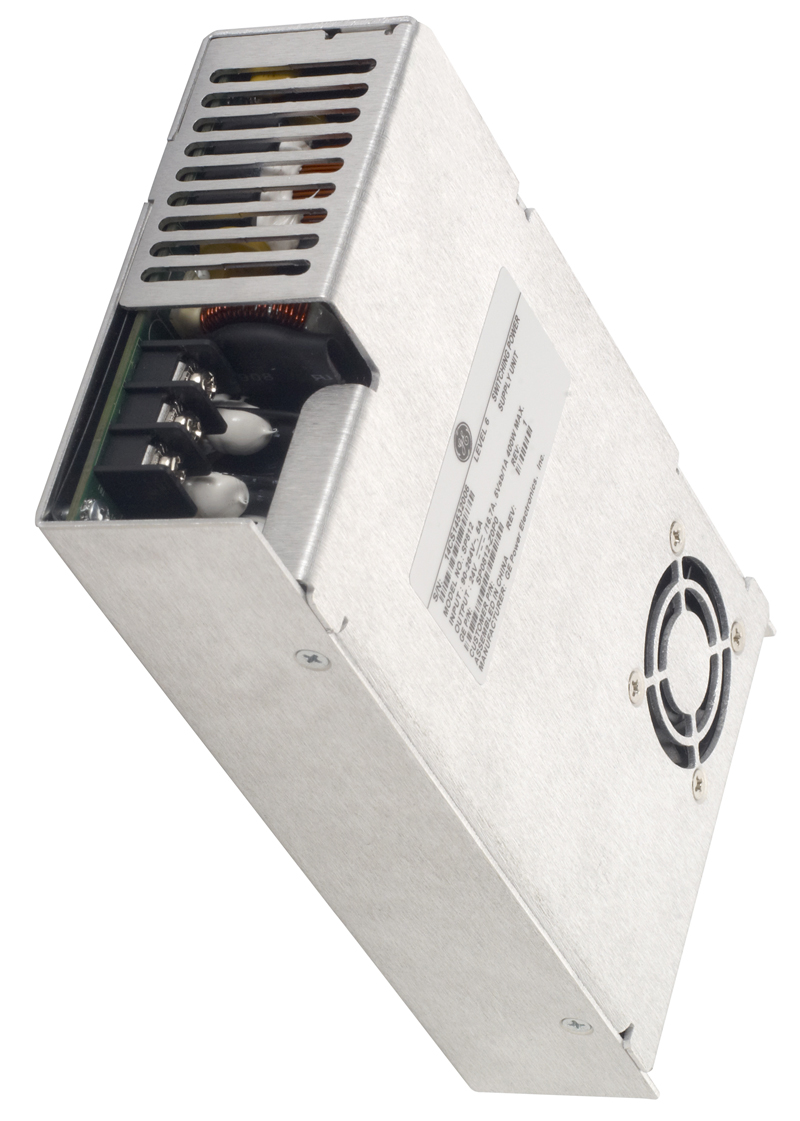
Power-supply manufacturers such as GE Critical Power have responded with products such as the CAR0424FP front-end unit. Operating from any mains supply worldwide, the CAR0424FP provides a highly efficient isolated power source for control computers and actuators (see Figure 1). The power supply is designed for applications where mid to light load efficiency is of key importance in order to reduce system power consumption where typical conditions involve the system operating significantly below peak load.
Click image to enlarge
Figure 1: The CAR0424FP front-end is designed for applications where mid to light load efficiency is of key importance
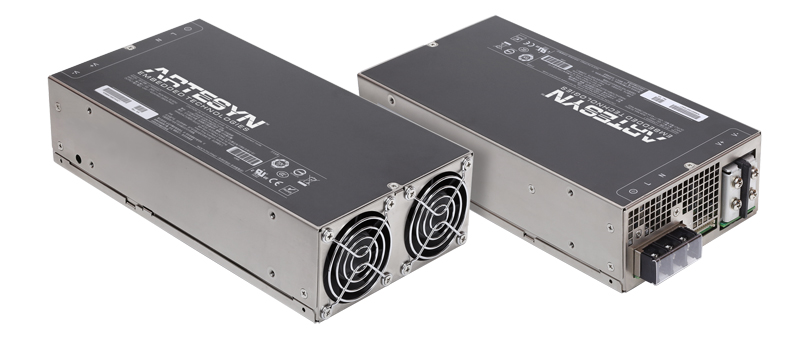
The Artesyn Embedded Technologies LCM1000 family of power supplies supports a number of energy saving and flexibility features (see Figure 2). A control loop implemented using a digital signal processor (DSP) optimizes efficiency across a wide load range and a high power density of 7.7W per cubic inch. The digital control allows the LCM supplies to be rapidly and easily modified to suit the needs of an application.
Click image to enlarge
Figure 2: Digital control allows the LCM supplies to be rapidly and easily modified to suit the needs of an application
Variable-speed ‘smart’ fans use software control algorithms developed by Artesyn to match fan speed to the unit’s cooling requirement and load current. Slowing the fan not only saves power but also reduces wear, thus extending its life.
DIN-rail mounting remains one of the most flexible ways to build machine controls from modular elements. Manufacturers have worked hard to improve the power delivery to these systems in terms of space and efficiency.
One example is the Mean Well NDR-240 series DIN-rail power supply. Measuring 63mm in width and operating from a 90V AC to 264V AC mains supply, the 240W supply is mounted in a metal housing design intended to improve airflow and reduce the need for cooling in environments with a high ambient temperature (see Figure 3). The 90 per cent efficient power converter operates within ambient temperatures from -20°C to +70°C using only convection cooling.
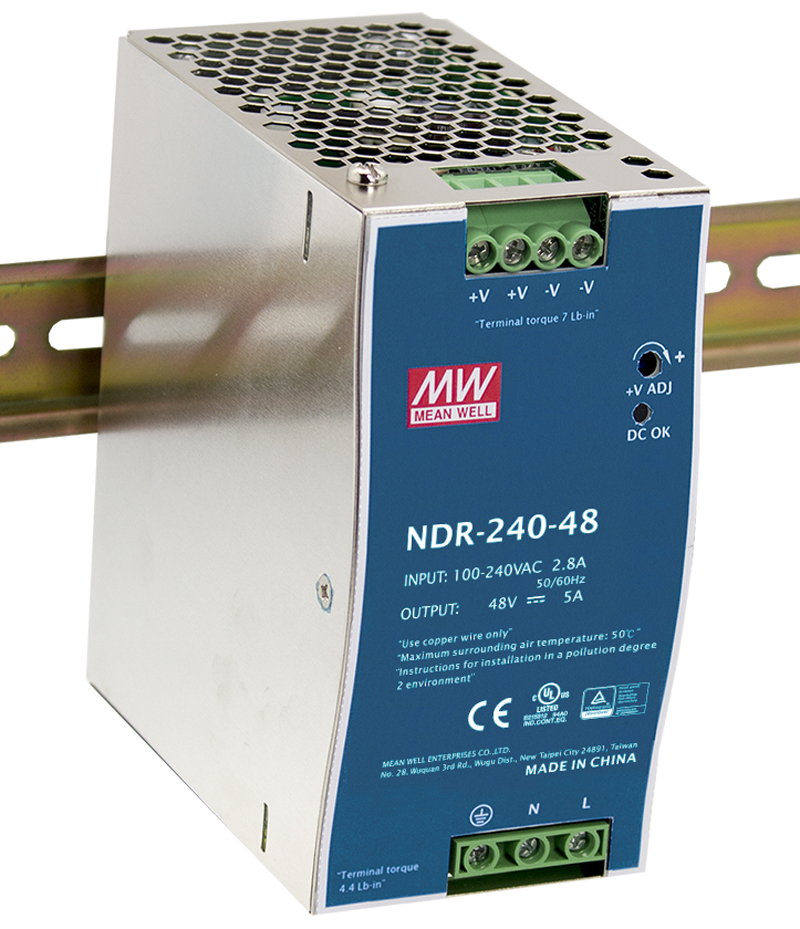
Click image to enlarge
Figure 3: The NDR-240 series DIN-rail power supply is mounted in a metal housing design intended to improve airflow
To allow use on smaller systems with short DIN rails or for greater density within a larger cabinet, the Sync series DRS-24V30W1AZ produced by Delta Electronics measures just 21mm in width. The 30W supply operates from a 90V AC to 264V DC mains supply and provides full output power up to an ambient temperature of 55°C.
For higher power density, the Cliq M series from Delta Electronics includes 80W, 120W, 240W, and 480W models rated at 24V, in a package that requires minimal space on a DIN rail length (see Figure 4). To deal with high startup demands, such as highly capacitive loads and motors, the Cliq M features a five-second 150% power-boost mode. This Advanced Power Boost (APB) function can prevent system shutdown due to a faulty load on a multiple load connection, delivering enough power in the event of a blown fuse in a faulty connection leg to maintain power to the other fused legs.

Click image to enlarge
Figure 4: The Cliq M features a five-second 150% power-boost mode
For the front panels of the control computers, and other systems that require panel interface and surface-mount compatibility, Grayhill has developed the 14 Series illuminated keyswitches. With an operational life of over 1 million cycles at full power, the pushbutton switches provide positive tactile feedback and are available with or without an IP67S seal for use in dirty environments. The surface-mount switches can be supplied with a variety of LED colours to allow easy visual segregation of controls.
Although Industry 4.0 means changes both to software and hardware architecture, the evolution of power, enclosure, connector and panel design is ensuring that machine builders, electronics designers and integrators can keep pace with the demands of the technology.