Power Architectures Boost the Next Generation of AI-Enabled New Space Missions
Satellite architectures are changing in fundamental ways
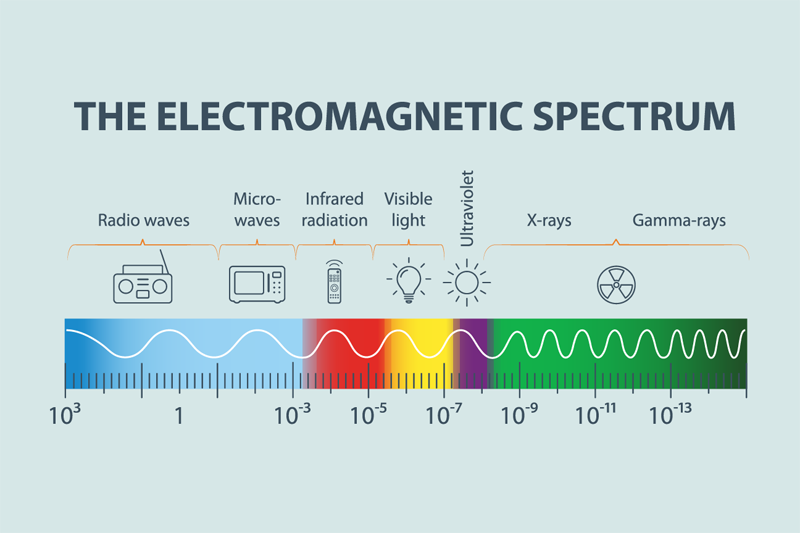
Figure 1: New Space electronics need added layers of protection against radiation exposure in space. For Low Earth Orbit (LEO) and Medium Earth Orbit (MEO) satellites electronics are typically required to meet radiation tolerant standards
Designers are putting high-performance compute in orbit for greater device autonomy and to process data before transmission. AI workloads, adaptive beamforming, dynamic spectrum management and onboard analytics all need processors that rival terrestrial edge devices in complexity and power demand. As these features become the norm, satellite designers can no longer ignore that power delivery, not compute capability, has become the limiting factor for mission performance.
Unfortunately, traditional space power architectures evolved from far lower current densities, slower load transients and more static operating profiles. AI workloads violate all three assumptions. Delivering optimal power for AI compute requires a fresh approach.
In the face of these new challenges, Spacechips has introduced the Spacechips AI1 Transponder Board, the first-ever edge processor in orbit. An architecture based on current multiplication, more current can be delivered to boost performance and reduces the size of the power delivery network.
The new reality of satellite compute loads
Satellite payloads are beginning to execute tasks that previously occurred exclusively on the ground. For example, satellites can now be expected to perform onboard inference, compression, routing and adaptive control. But increasingly high-performance low-earth orbit (LEO) processing requires next-generation power. Satellite operators are offering more sophisticated on-board processing capabilities necessitating the use of the latest deep-submicron FPGAs and ASICs.
In the case of Spacechips, the company wantedto develop an AI-enabled satellite transponder capable of performing advanced signal processing and machine-learning tasks directly in orbit, rather than relying on ground-based computation. That goal required placing AI-class processors inside the communications payload itself. To that end, the AI1 Transponder features two processing engines: a deep-submicron FPGA and a quad-core MCU, each with an AI accelerator.
Meanwhile, these devices operate at core voltages that continue to decrease while current demand sharply increases. OEMs are challenged to offer more functionality from smaller payloads and platforms, and the resulting low-voltage, high-current power requirements are demanding. Where hundreds of amps from a sub-1V rail used to be the exception, it has become the rule for AI-class processing in orbit.The AI1 Transponder in particular operates at core voltages of 0.8V and draws about 130 amps.
Load behavior further complicates delivery. AI accelerators generate fast, discontinuous current transients as workloads change between idle, inference and burst operation. Voltage droop or noise during these transitions can degrade performance or force conservative clocking. With limited local capacitance, power delivery networks need to respond in microseconds without compromising tight voltage margins.
Environmental and system constraints that shape New Space power design
In general, New Space power design operates under constraints that reinforce each other. For example, relatively smaller satellites are desirable to reduce launch costs. But smaller satellites harvest less energy commensurate with their size. With operators increasingly using faster and more on-board processing, there is a requirement that as much of the possible power budget is available for the payload.
At the same time, expert space designers like Spacechips face challenges around thermal management.
On the one hand, heat generation is rising. As current density increases, resistive losses in power planes and connectors do too. Without proper thermal management, junction temperatures rise, reliability margins decrease, and designers can’t achieve maximal power density.
On the other hand, space environments limit thermal dissipation strategies. In the absence of airflow, waste heat from the power delivery network must be dissipated through the satellite’s mechanical structures. As a result, thermal dissipation requirements drive mechanical design decisions and force tradeoffs between structural layout, mass and available volume for payload and electronics.
Finally, radiation exposure adds another layer of complexity to the PDN (Figure 1). Radiation-induced parameter shifts can reduce voltage margin on already low-voltage rails. Single-event disturbances can coincide with load transients and disrupt regulation. Therefore, power components need to tolerate total ionizing dose and single-event effects without introducing excessive mass or cost
Why traditional space power architectures fail to scale
In the face of all these converging challenges, Spacechips realized that traditional space power architectures falter.
Traditional power-distribution architectures comprising an isolated DC-DC to step-down the external bus input, followed by localized PoLs regulators to produce the required load voltages, are becoming too inefficient because of large I2R drops. As designers push more current through low-voltage buses, distribution losses grow quadratically and consume an increasing share of available power.
To deliver the next generation of New Space missions,Spacechips needed improvements in conversion loss, power density, physical size and a transient response compatible with the switching speeds of the latest deep-submicron devices. Traditional PWM-based converters struggle to meet these demands. Square-wave switching introduces harmonics that require additional filtering, which adds mass, occupies board area and increases load impedance. Control loops often respond too slowly to rapid current transients and force designers to rely on large decoupling networks that further erode SWaP margins.
At high current levels, these architectures impose a hard limit on usable compute regardless of processor capability.
Using a Factorized Power Architecture which multiplies current
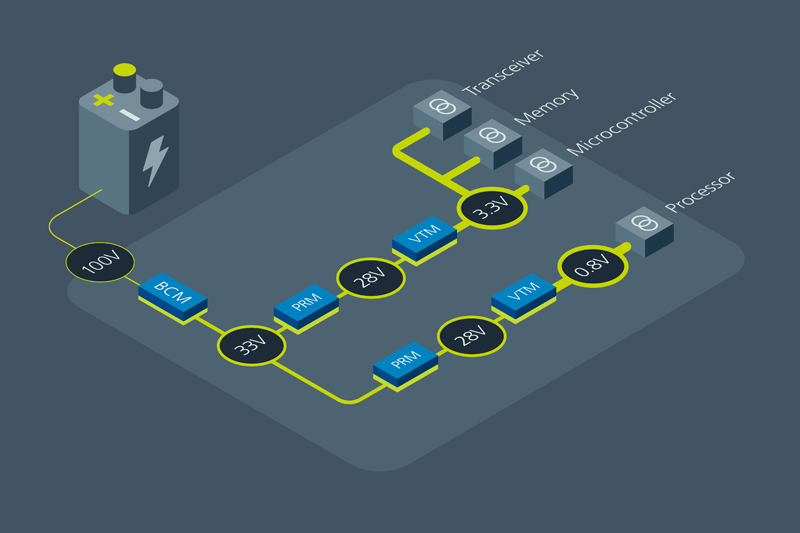
Rather than optimizing legacy designs, Spacechips collaborated with Vicor to design a fresh, new approach to a modern power architecture based on a Factorized Power Architecture (Figure 2)
Click image to enlarge
Figure 2: Factorized Power Architecture (FPA) separates the functions of DC-DC conversion into independent power modules which serves to multiply the current.
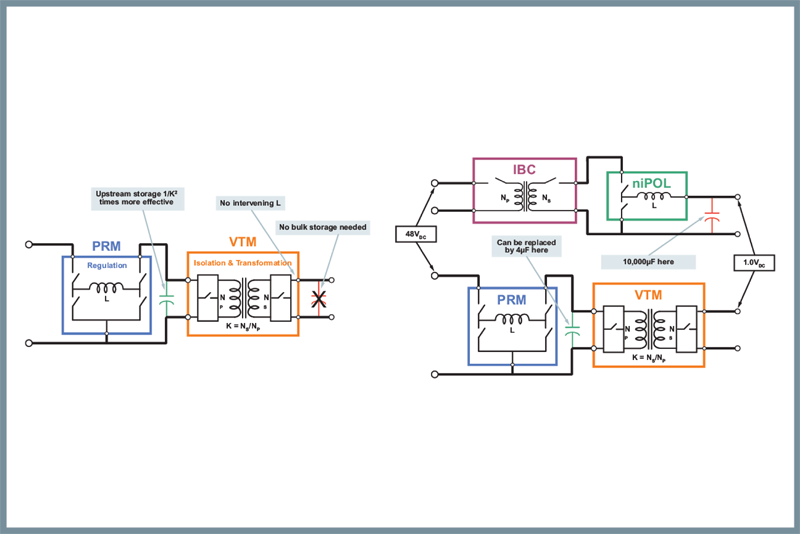
Factorized Power Architecture changes where and how current flows within the power delivery network (Figure 3). Instead of distributing large currents at low voltage throughout the satellite, the architecture distributes power at a higher voltage and lower current. It then converts that power to the required low-voltage, high-current rail directly at the load.
The approach separates voltage regulation from voltage transformation. A regulation stage first generates a stable, higher-voltage intermediate rail that can tolerate distribution losses and environmental variation. Power then moves through the spacecraft at this elevated voltage, which significantly reduces current for a given power level.
For example, a 48V bus requires four times less current than a 12V bus for the same power, and distribution losses reduce by a factor of sixteen. Lower current reduces resistive losses and improves thermal behavior across the power distribution network.
Click image to enlarge
Figure 3: Comparing architecture: Note the how FPA differs a traditional, intermediate architecture
A dedicated transformation stage then performs a fixed-ratio voltage step-down close to the load. In this stage, a DC transformer converts the higher-voltage intermediate rail to the desired load voltage, and stepping down the voltage increases the current by the same ratio. This transformation inherently multiplies current.
Designers can therefore deliver high current where the processor needs it without pushing that current through the entire distribution path.
Electrical advantages of a Factorized Power Architecture for AI loads
Current multiplication addresses modern stress points by lowering the effective impedance seen at the load. By placing the transformation stage near the processor and minimizing the length of high-current paths, the architecture reduces resistive and inductive elements that contribute to voltage droop.
The transformation stage also delivers an inherently fast transient response. Because it does not rely on a slow feedback loop to regulate output voltage, the conversion stage can respond to load changes within microseconds. Very low output impedance allows the supply voltage to stay stable even during abrupt transitions between idle and peak AI workloads. The result is less droop and overshoot that could otherwise destabilize the processor.
Supplying Spacechip’s required combination of ultra-low voltage and extremely high current with conventional point-of-load regulators would have consumed significantboard area and imposed severe thermal and routing constraints. In short, the power delivery network would have limited how much compute Spacechips could practically deploy.
Spacechips also benefited from Vicor resonant conversion technology. Soft-switching, sinusoidal current flow reduces high-frequency harmonic content compared to hard-switched converters. With lower conducted and radiated EMI as a result, less filtering is required, more board space is available, and overall efficiency is improved.
In addition, current multiplication enables capacitance multiplication at the load. The effective shunt capacitance increases by the square of the transformation ratio, which provides substantial transient energy storage without relying on large banks of physical output capacitors.
The case for rad-tolerant power
Current multiplication also changes how designers need to approach radiation tolerance in the power delivery network.By combining Vicor proprietary current multiplication approach, known as a Factorized Power Architecture (FPA) and radiation-tolerant product line, the groups designed a more efficient, flexible and power-dense solution.
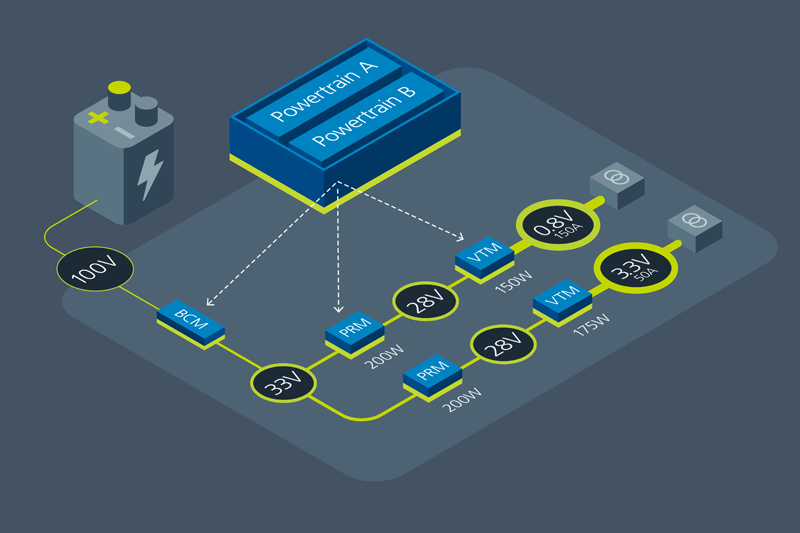
In conventional low-voltage distribution architectures, power converters regulate and deliver high current directly across the board. This approach exposes a small number of components to the risks of radiation. Designers often respond by specifying fully rad-hardened parts to preserve margin, even when the mission environment does not strictly require them. Current multiplication relaxes these constraints by decoupling regulation accuracy from high-current delivery (Figure 4).
The regulation stage operates at a higher voltage and lower current, with larger absolute voltage margins and lower transient stress. Radiation-induced parameter shifts therefore consume a smaller fraction of the available margin, and the regulation function is more tolerant of drift and single-event disturbances. Meanwhile, the transformation stage performs fixed-ratio conversion without relying on a tight feedback loop. That reduces susceptibility to radiation-induced control upsets during fast load transients.
Click image to enlarge
Figure 4: Vicor radiation-tolerant COTS source-to-point-of-load power delivery simplifies design by integrating the full power chain.
By decoupling regulation from high-current delivery, the AI1 transponder is radiation-tolerant and rugged, since Spacechipscan design for radiation effects at the system level rather than hardening every component in isolation. Vicor modules also feature a dual powertrain, providing built-in redundancy that allows loads to be driven at 100 percent on each side for fault-intolerant space applications.
As a result, many LEO and MEO platforms can rely on rad-tolerant power components instead of fully rad-hardened devices. Rad-tolerant solutions avoid the cost, mass and qualification overhead associated with rad-hard certification while still meeting mission reliability targets. Designers also gain flexibility in component selection and can avoid SWaP penalties associated with rad-hard parts.
Factorized Power Architecture redefines the ceiling for powering AI in space
As satellites adopt higher levels of onboard intelligence, power architecture will define system capability. For AI-enabled satellites, advances in power delivery determine how much computation satellites can perform, how reliably they can perform it and how autonomous future space systems can become.
By taking a new approach to power delivery, Spacechips and Vicor are able to design the most power-dense processor board in orbit. The Spacechips’ AI1 transponder leverages a Factorized Power Architecture to boost performance well beyond the competition. The system delivers the highest current power for in-orbit processing. FPA combines high-density power modules with a propriety architecture and a system design that is fundamentally different and higher performing than legacy discrete systems. Together Vicor and Spaceships are enabling innovation in space by redefining the power delivery network and how in-orbit computer processing is achieved.