AURORA MICRO inverters minimise losses
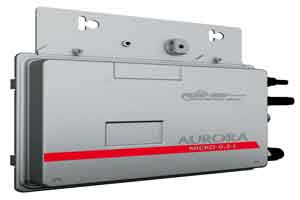
Power-One has announced the availability of its new MPPT (maximum power-point tracking) panel-level micro-inverters, the AURORA MICRO-0.3-I and AURORA MICRO-0.25-I. These inverters, which boast efficiency ratings up to 96.5% and includes the AURORA CDD communications device, expands the AURORA product portfolio to cover applications with variation in module production. The AURORA MICRO and the complimentary AURORA CDD are now available in limited quantities to the US Market and will ramp up to full availability in Q4 of 2012. "How micro-inverters will be incorporated into the solar installations of the future is currently one of the hot topics within the residential PV industry," said Paolo Casini, VP of Power-One product marketing. "It is our belief that micro-inverters will soon become a very popular option for residential installers, as the setup times will be reduced without affecting the installation's energy-harvesting capabilities. In addition, micro-inverters also reduce the susceptibility to fault: in case of a component failure only the energy produced from the affected PV module will be lost." The AURORA MICRO-0.3-I and AURORA MICRO-0.25-I. devices are directly connected to each individual solar panel, so there is no need for string sizing nor any topology or orientation constraints within the PV modules. The micro-inverters also allow for a significant reduction of the effect of module ageing. Power-One's AURORA MICRO micro-inverters offer many benefits to small rooftop installations including the speed and ease of installation, increased control of individual panels and maximized energy harvesting for every installation, regardless of its size. One of the main benefits of equipping each module with its own micro-inverter is that each panel benefits from a separate MPPT, which creates the optimum power curve for any light conditions. This does not only minimize efficiency losses from partial or temporary shading, but also from panel mismatching. Moreover, the units ensure system expandability at panel level without the hassle of string re-sizing or panel matching. Additional features of the AURORA MICRO micro-inverters include a rugged outdoor enclosure and HF isolation allowing to fit any application which requires the grounding of either one of the DC input terminals. The units are electrolyte-free to further increase the product lifetime and long term reliability. As there are no high voltage DC BoS components, the installation of the micro-inverters is very easy. Additional features of the AURORA MICRO micro-inverters include a rugged outdoor enclosure and isolation allowing the micro-inverters to fit any application which requires grounding one of the DC input terminals. The units are electrolyte-free to further increase the product lifetime and long term reliability. As there are no high-voltage DC BoS components, the installation of the micro-inverters is very easy. The AURORA CDD is the proprietary wireless communication hub and grid interface provides the homeowner an instantaneous view and historical view of the energy production through the AURORA Integrated Web Server or via the internet through the AURORA Easy View. Power-One Renewable-energy deeplink
.jpg)