A look into the factors that require power supply derating and how derating can improve industrial power supply reliability and extend MTBF.
Figure 1: Typical derating curve showing maximum power rating vs. ambient temperature (RP15-A DC/DC series)
Power supplies are specified for their ability to deliver up to a certain maximum rated wattage under normal operating conditions. For example, a power supply may be listed as a “480W power supply” or a “15W DC/DC converter”. However, this power rating depends on the operating conditions. External factors such as high or low ambient temperatures, a low input voltage, and high operating altitudes can lower the continuous maximum power that can be delivered.
To compensate, it is necessary to lower the load of the power supply – a practice referred to as derating. Derating ensures reliable operation and long life by reducing the internal power dissipation to lower the heat generated and to maintain a high reliability throughout the entire expected lifetime of the product. Industry standard guidelines state that for every 10°C rise in ambient temperature, service life decreases by half.
Specification and Impact
Typically, power supply manufacturers specify derating with a graph or a formula. RECOM provides both temperature-based and input-voltage-based derating curves supplemented by a percentage derating, which increases as the altitude increases. In addition, absolute load limits may be applied as needed.
Temperature derating curves feature ambient temperature on the X-axis and power output on the Y-axis. Derating is necessary when the output power must be decreased based on the ambient temperature to stop the power supply from overheating. Table 1 shows the impact of derating at different loads and temperatures on the power supply lifetime expectancy.

Click image to enlarge
Table 1: Reliability impact of derating on power supply lifetime
The Misconception in Terms of Designed-In Headroom
Power supply specifications usually include a certain headroom to allow for higher load inrush currents or input surge and transient voltages. However, the absolute maximum (abs. max.) values should not be used for normal operation when choosing a power supply. This headroom is a factor of the robustness of the design and its ability to survive short-term anomalous events. These maximum values do not represent power performance data that can be used over an extended time.
Click image to enlarge
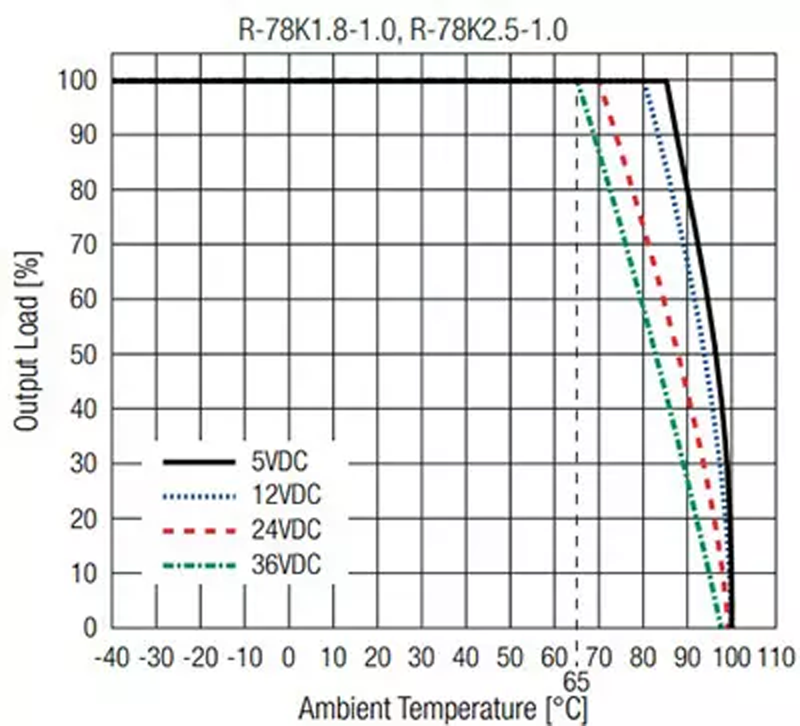
Figure 2: Derating curve with input voltage charted along with load and ambient temperature (R-78K1.8-1.0, R78K2.5-1.0)
Search and Interpretation of Derating Curves
RECOM places the derating curves for its industrial automation power supplies near the end of the product datasheets. Other manufacturers might place them in application notes or in separate reference materials.
Figure 2 illustrates different derating curves for different supply input voltages for a wide input voltage switching regulator (R-78K series). Because switching regulators become less efficient as the input voltage increases, the components reach their load limits more quickly. As a result, derating begins earlier than at lower input voltages.
In this case, the combination of a 5V input voltage and a 2.5V output voltage results in low power dissipation, so the converter experiences virtually no thermal stress and can deliver full power up to an ambient temperature of 85°C. However, if the same load is supplied with an input voltage of 36V, derating must begin as early as 65°C.
RECOM publishes reliability data in their product datasheets. The switching regulator datasheet for the R-78K-1.0 series (shown in figure 2) lists an MTBF according to MIL-HDBK-217F of 5139 x 10³ hours at +25°C (variants R-78K2.5-1.0 through R-78K15-1.0 range from 4990 x 10³ to 4546 x 10³ hours).
Multi-Factor Derating in Power Supply Applications
While internal heat dissipation is a primary derating consideration, it is not the only one. Operating altitude is also a factor because of the reduced cooling capability of thinner air. In combination with higher input voltages the use of the power supply in higher altitudes will further reduce the thermal margin, resulting in a steeper derating curve.
Key Environmental and Electrical Derating Factors
- Ambient temperature
- Operating altitude
- Input voltage (level and AC or DC)
- Load type (capacitive, inductive, or dynamic versus resistive)
- Ventilation
Altitude-related derating comes in graph or text form. For example, in the “Environmental Conditions” section of the datasheet for the R-78K-1.0 series switching regulator RECOM specifies a maximum operating altitude of 5,000 meters. The document further specifies that derating starts at an elevation of 2,000 meters. Between 2,000 meters and 5,000 meters, the maximum supply power derating is 5% for every 1,000 meters of elevation difference. Altitude derating adds to thermal derating.
Click image to enlarge
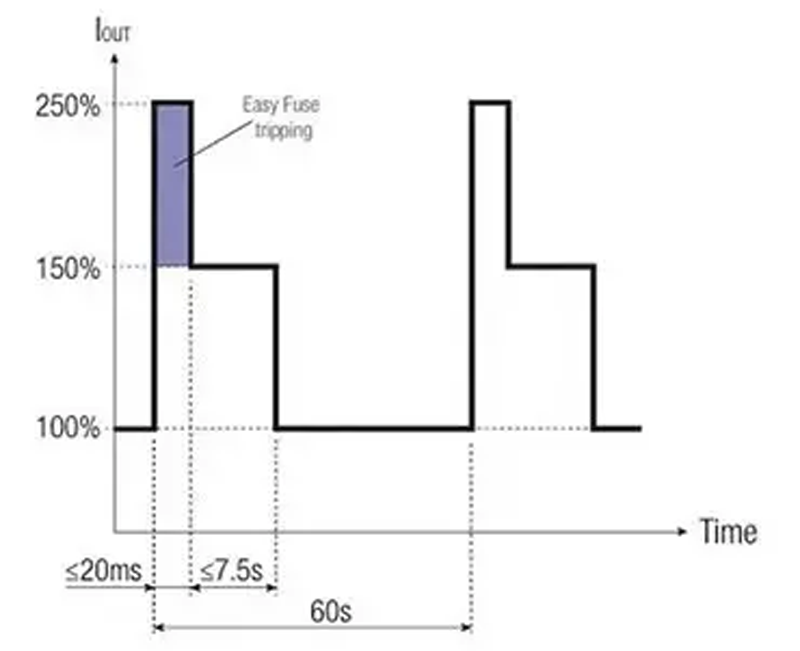
Figure 3: Peak load dwell time and cycle time graph for RACPRO1-T480 (percentages shown are post-derating)
Derating and Peak Power
Loads with a high capacitive component, such as motor drivers or battery charging circuits, require high surges of inrush current at startup. These surges can be 10 times to 50 times the steady-state current for a few milliseconds or several dozens of milliseconds. The power supply must be able to handle these inrush currents without going into over-current protection while still responding to short-circuit events.
The above graph shows the output overcurrent-handling capability of a RECOM DIN rail power supply (RACPRO1-T480 series). A 100% load can be handled continuously. Up to 150% of the rated current is acceptable as long as these events do not last longer than 7.5 seconds and do not occur more often than once every 60 seconds. In the event of a short circuit at the output, the power supply delivers up to 250% of the rated current for 20ms to securely trip any fuses on the output.
Ventilation and Heat Sinks
Most industrial supplies operate within an enclosed cabinet, which means that they operate in an environment that may or may not have forced ventilation. Forced air increases the risk of dust accumulation and provides less heat dissipation than one might think.
Click image to enlarge
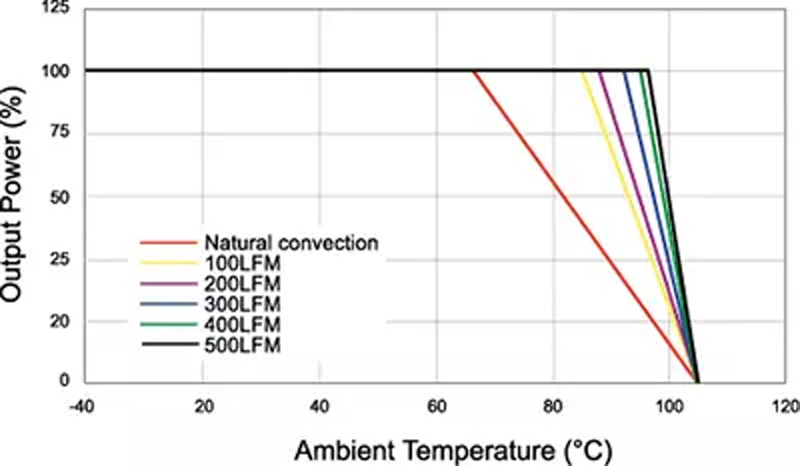
Figure 4: The derating curve includes airflow as a factor and shows the positive effect of the airflow and its limitations on power output capability (RECOM DC/DC Book of Knowledge)
Figure 4 shows a representative derating curve and the effects of the cooling airflow. With no airflow, derating must start at approximately 67°C. Active cooling of 100 linear feet per minute (LFM) increases the derating start point to approximately 85°C. Additional airflow delivers only limited returns: With 500 LFM, the derating start point moves to approximately 95°C.
Practical Limits of Derating
Derating has its limits. Regardless of the extent of the derating, safe operation can no longer be guaranteed above a certain temperature. Power supplies typically lose efficiency as the load nears zero. This factor, combined with the risk associated with ambient temperature, leads to a point at which power reduction at high temperatures and high altitudes is only partially effective—if at all.
What is the Difference Between AC/DC and DC/DC Power Supply Derating?
The primary difference is that AC/DC derating must account for the additional thermal and electrical stresses of front-end rectification, power factor correction (PFC), and wider input voltage variables, whereas DC/DC derating focuses mainly on local thermal management and operation altitude.
AC/DC converters are subject to the same basic considerations as DC/DC converters. However, AC inductive loads bring the unique risk of lagging power factor (phase difference between current and voltage) under heavy loads and back EMF when switching off the load. Both can drive a power supply beyond its operating limits. RECOM AC/DC power supply design accommodates these challenges, which are typical for AC loads, by offering high inrush current capability and high return voltage immunity.
Summary
Power supply derating is an important consideration when building industrial automation systems. Derating ensures that your power supplies can reliably deliver adequate power throughout the installation’s lifecycle. It prevents extreme environmental and operational conditions from severely reducing the supply’s lifetime and reduces the risk of supply disruption due to early failure.