How Swappable Battery Systems Are Reshaping Power Management for Industrial and Medical OEMs
The pressure on industrial and medical equipment manufacturers has never been more intense. Customers demand higher uptime, leaner operating costs, and power systems that adapt to the job rather than dictating its terms. Traditional fixed-battery architectures — solid and predictable as they may be — are increasingly a poor fit for environments where a depleted battery means a stalled workflow, a missed delivery window, or, in clinical settings, a disruption that carries real consequences.
Swappable battery platforms are emerging as a practical answer to this challenge. But making them work reliably, safely, and without nuisance interruptions requires engineering discipline that goes well beyond simply building a battery with a quick-release latch. Understanding what separates a well-designed swappable system from a problematic one matters for any OEM or engineer evaluating these solutions today.
Why Fixed Power Is Losing Ground
For years, integrated battery systems were the default choice. They were simple, predictable, and easy to certify. The trade-off — mandatory downtime for recharging — was considered an acceptable cost of doing business.
That calculus is changing. Logistics operations run around the clock. Field service teams can't afford to wait at a charging station. Medical carts need to stay powered through full shift rotations without retreating to a docking bay. In each of these scenarios, the minutes lost to recharging accumulate into hours, and those hours have measurable dollar values attached to them.
The response from the market has been a shift toward swappable battery architectures — systems where a depleted pack is pulled and replaced with a fully charged one in seconds, keeping equipment operational without interruption. For example, hospitals no longer line up workstations to recharge as seen in figure 1 and warehouses are increasingly relying on high use workstations (figure 2). This model shifts the "recharging" activity away from the machine and onto a separate charging station, decoupling energy replenishment from productive equipment time.

Click image to enlarge
The operational math is straightforward. Instead of waiting 60 to 90 minutes for a battery to recharge, an operator swaps in a fresh pack and keeps moving. A team running multiple batteries in rotation effectively eliminates charging downtime as a bottleneck entirely.
The Case for LiFePO4
Not every battery chemistry is suited to the demands of a hot-swappable system in heavy-use industrial or medical environments. Lithium Iron Phosphate — LiFePO4 — has emerged as the chemistry of choice for this application category, and the reasons go beyond marketing preference.
LiFePO4 offers significantly higher cycle life than conventional lithium-ion chemistries. Where standard lithium-ion packs may become unreliable after 500 to 800 cycles, LiFePO4 cells routinely deliver thousands of cycles at usable capacity. In high-rotation swap environments, where a battery might go through multiple charge-discharge cycles per day, this difference in cycle life has a direct impact on total cost of ownership.
Thermal stability is equally important. LiFePO4 has a fundamentally more stable chemical structure than nickel-manganese-cobalt or nickel-cobalt-aluminum chemistries. It operates at lower internal temperatures and is far less susceptible to thermal runaway — a critical consideration when batteries are handled, swapped, and charged in dynamic field conditions rather than controlled environments.
There's also a supply chain and environmental dimension worth acknowledging. LiFePO4 relies on iron, an abundant and non-toxic material, unlike the cobalt and manganese used in other lithium chemistries, which are both scarce and often sourced from geopolitically unstable regions. For manufacturers building long-term product strategies, that supply resilience matters.
The Technical Hurdle: Nuisance Tripping
Swappable batteries introduce a class of engineering challenges that don't exist in fixed-battery systems, and one of the most significant is nuisance tripping — the unintended activation of the battery management system's (BMS) protective shutdowns during normal operation.
Every lithium-ion battery requires a BMS to monitor voltage, current, and temperature and to prevent conditions that could damage the cells or create safety hazards. In a static, single-battery configuration, these systems are relatively straightforward to manage. In a hot-swappable parallel configuration, they become considerably more complex.
Three issues commonly drive nuisance tripping in these systems.
Overcurrent from low internal impedance. LiFePO4 batteries, like all lithium-ion chemistries, have low internal impedance — which is part of what makes them efficient. But low impedance also means that surge currents during connection events can be fast and large. If the BMS circuitry isn't designed with adequate filtering and protection mechanisms, those transients can read as fault conditions and trigger a shutdown that was never operationally necessary.
Mismatched state of charge during hot swap. When a depleted battery is connected in parallel with one or more batteries at a higher state of charge, current flows rapidly from the higher-charge pack to the lower-charge one. This equalization current can spike high enough to exceed the BMS's thresholds, causing one or more batteries to drop offline. The result is an interruption that the operator didn't expect and the system didn't need to cause.
Uneven load sharing in parallel configurations. When multiple batteries run in parallel, small differences in cable length, contact resistance, or cell impedance can cause one battery to carry a disproportionate share of the current load. If that imbalance pushes a single pack beyond its current limits, the BMS trips — again creating an unnecessary interruption.
Solving these problems requires deliberate design at the system level, not just at the cell level. Pre-charge circuits, inrush limiters, carefully matched impedance paths, and BMS firmware tuned for parallel operation all contribute to a system that handles the realities of hot swapping without generating false fault conditions. A patented approach to managing these dynamics — one that allows batteries to be swapped mid-operation without triggering protective shutdowns — represents the kind of engineering investment that separates purpose-built swappable platforms from adapted general-purpose solutions.
What a Complete Platform Looks Like
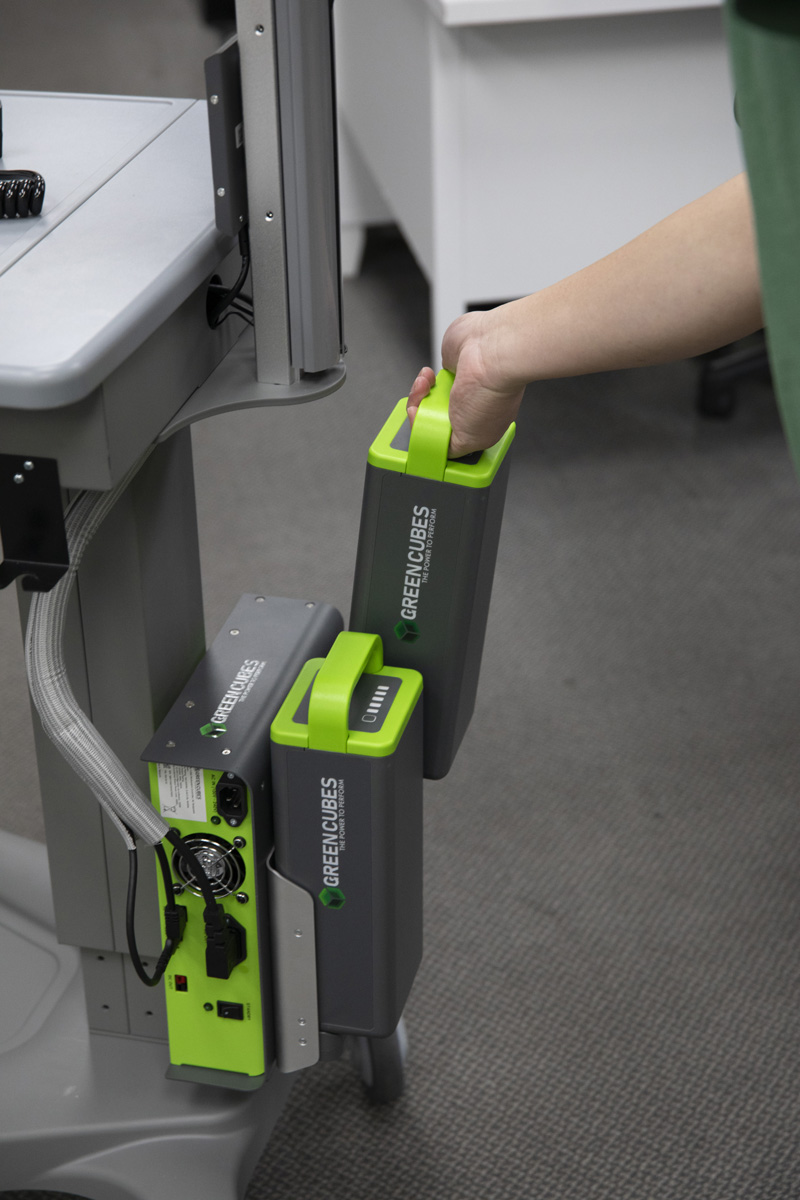
A mature swappable battery platform integrates three elements: the battery assembly itself, a cart power module that manages system-level power delivery, and a dedicated charger. An example of a complete swappable battery system is in figure 3.
Click image to enlarge
The battery assembly should deliver meaningful capacity and output. A well-specified pack for industrial cart and workstation applications — such as a 290Whr unit operating at 19.2V nominal with up to 300W continuous output — provides enough headroom for demanding devices while remaining physically manageable for frequent swapping. Compliance with IEC 62133 sets a global benchmark for battery safety and performance.
The cart power module is where system flexibility lives. A module that supports one or two batteries, delivers 300W continuous output, and accommodates both 120VAC at 60 Hz and 230VAC at 50 Hz gives OEMs a platform that works across global markets without hardware redesign. Integrated backup capacity — even a short window of a few minutes — is what makes true hot swapping possible, bridging the instant between battery removal and insertion without dropping power to connected equipment. IEC 60601 compliance is non-negotiable for medical applications and signals the level of engineering rigor applied to the design.
The charger closes the loop. The ability to charge two or four batteries simultaneously, with universal input compatibility and compliance with both IEC 60601 and IEC 62368, keeps inventory rotating efficiently and ensures the charging infrastructure matches the pace of operations in the field.
A Forward-Looking Perspective for OEMs
For OEMs designing the next generation of industrial carts, mobile workstations, and medical equipment, the power architecture decision made today will shape product competitiveness for years. Customers evaluating equipment increasingly factor total operating cost — not just purchase price — into their decisions. A platform that eliminates charging downtime, extends battery life through better chemistry, and simplifies field maintenance through individual battery serviceability delivers value that shows up in operations, not just in spec sheets.
The swappable battery model also positions products for adaptability. As cell technology continues to advance, a modular swap-based design allows battery packs to be upgraded independently of the host equipment. That kind of future-proofing is difficult to achieve with integrated systems and represents a real advantage in product life cycle planning.
The power needs of industrial and medical environments aren't getting simpler. But with the right swappable battery platform — built on proven chemistry, sound BMS engineering, and a complete system approach — they're becoming significantly more manageable.