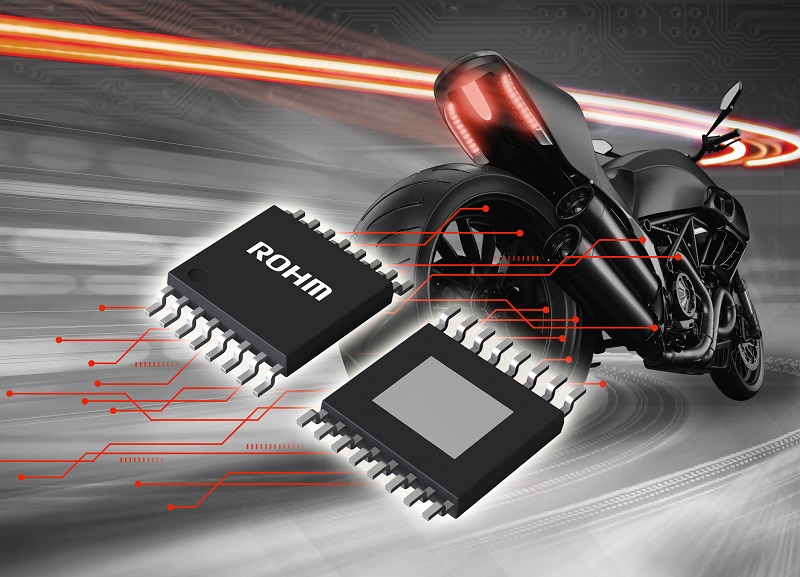
ROHM’s 4ch linear LED driver IC with built-in MOSFET is ideal for LED rear lamps (turn/stop), fog lamps and turn signals for automotive use.
The adoption of automotive-grade LED lamps is advancing in terms of power savings and design flexibility, while the number of lamps and brightness levels are increasing significantly. Vehicle manufacturers demand simpler circuits for rear and license plate lamps in order to reduce costs and shorten development time.
Following market requirements, ROHM developed its newest LED drivers, the BD183x7EFV-M (BD18337EFV-M / BD18347EFV-M) series which incorporate a proprietary thermal dissipation circuit and individual LED control function.
To minimize board area, output channels are consolidated into a single terminal, allowing a configuration a 4ch high output (150mA/ch) driver into a compact 16pin package. Further, the individual LED control function allows driving LED lamps with different specifications by one driver. To reduce design effort, heat distribution circuit allows simplification of the overall thermal design. The LED control function enables individual or collective control of LEDs in case of errors, to comply with motorcycle standards for license plate lighting. Individual dimming function supports sequential lighting for greater design versatility along with protection functions to protect the LED driver and peripheral circuits.
Key Features
The BD183x7EFV-M (BD18337EFV-M / BD18347EFV-M) series leverages thermal dissipation circuit and individual LED control function, that significantly reduces both board area and application design load for LED lamps.
(fig. 2)
1. Minimizes total board area
1-1. Heat distribution circuit enables high power 4ch output in a compact size
ROHM's heat distribution circuit consolidates the heat dissipation terminals into one to achieve higher output power (150mA/ch) in a compact 16pin form factor while increasing the maximum number of channels to 4. In conventional vehicle rear-lamp systems, 2 LED drivers are needed to power 4 LED strings. ROHM's new ICs make it possible to drive all 4 strings with just one driver, significantly reducing the number of parts along with mounting area.
1-2 LED individual control function drives 2 LED lamps with different specifications
ROHM's new ICs integrate an individual LED control function that can simultaneously drive 2 different types of LEDs, minimizing board area by reducing the number of ICs by half compared to existing systems, which require 2 ICs to drive same number of LEDs.
2. Significantly reduces design effort
2-1 ROHMs heat dissipation circuit minimizes thermal design man-hours
The BD183x7EFV-M series incorporates a thermal distribution circuit that consolidates the multiple heat dissipation circuit terminals into one, significantly reducing design effort by allowing thermal design typically required for each channel to be completed in a single design step.
2-2 Individual LED control function supports development of variants for different regions
The built-in control function allows to select either collective or individual LED OFF, in case a rear lamp fails to light up. Designers can select to turn all LEDs OFF or only the failed string, enabling the compliance with multi-regional laws with one single setting, reducing the number of redesign man-hours considerably.
(fig. 3)
3. Sequential lighting compatibility provides greater design versatility
The BD183x7EFV-M series provides an individual dimming function for sequential lighting by adding external resistors.
4. Multiple built-in protection functions protect the circuit during abnormalities
Open/short detection for vehicle lamps, abnormality detection for each channel and other protection functions prevent damage to the circuit, LED driver and peripherals.
www.rohm.com/eu