Researchers create solar tech that captures high-energy photons more efficiently
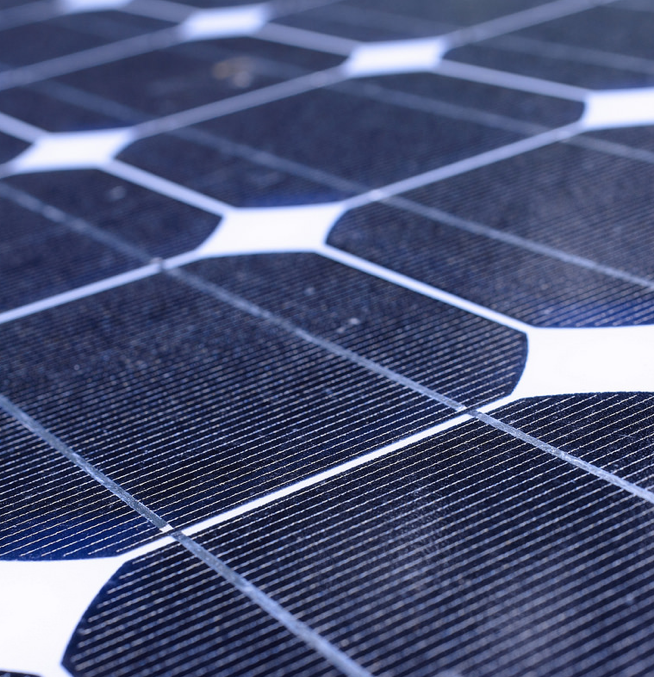
Scientists at the U.S. Department of Energy’s Argonne National Laboratory and the University of Texas at Austin have together developed a novel, inexpensive material that has the potential to capture and convert solar energy — particularly from the bluer part of the spectrum — much more efficiently than ever before.
Most simple solar cells handle these bluish hues of the electromagnetic spectrum inefficiently. This is because blue photons — incoming particles of light that strike the solar cell — actually have excess energy that a conventional solar cell can’t capture. “Photons of different energies kick electrons up by different amounts,” said University of Texas Professor Brian Korgel. “Some photons come in with more energy than the cell is optimized to handle, and so a lot of that energy is lost as heat.”
Because of this limitation, scientists had originally believed that simple solar cells would never be able to convert more than about 34 percent of incoming solar radiation to electricity. However, about a decade ago, researchers saw the potential for a single high-energy photon to stimulate multiple “excitons” (pairs of an electron and a positively-charged partner called a “hole”) instead of just one. “This was a very exciting discovery, but we were still skeptical that we could get the electrons out of the material,” Korgel said.
In their study, Korgel and his team used specialized spectroscopic equipment at Argonne’s Center for Nanoscale Materials to look at multiexciton generation in copper indium selenide, a material closely related to another more commonly produced thin film that holds the record for the most efficient thin-film semiconductor. “This is one of the first studies done of multiple exciton generation in such a familiar and inexpensive material,” said Argonne nanoscientist Richard Schaller. “Argonne’s spectroscopic techniques played a critical role in the detection of the multiexcitons,” Korgel said. “These kinds of measurements can’t be made many places.”
In order to deposit thin films of the nanocrystalline material, the researchers used a process known as “photonic curing,” which involves the split-second heating up and cooling down of the top layer of the material. This curing process not only prevents the melting of the glass that contains the nanocrystals, but also vaporizes organic molecules that inhibit multiple exciton extraction.
Although the study mostly proves that the efficiency boost provided by multiple exciton extraction is possible in mass-producible materials, the major hurdle will be to incorporate these materials into actual real-world devices. “The holy grail of our research is not necessarily to boost efficiencies as high as they can theoretically go, but rather to combine increases in efficiency to the kind of large-scale roll-to-roll printing or processing technologies that will help us drive down costs,” Korgel said.
A paper based on the study recently appeared in the Journal of Physical Chemistry Letters. The study was supported by grants from the Department of Energy’s Office of Science and the National Science Foundation.