ROHM op-amps suit motion-sensor signal amplification
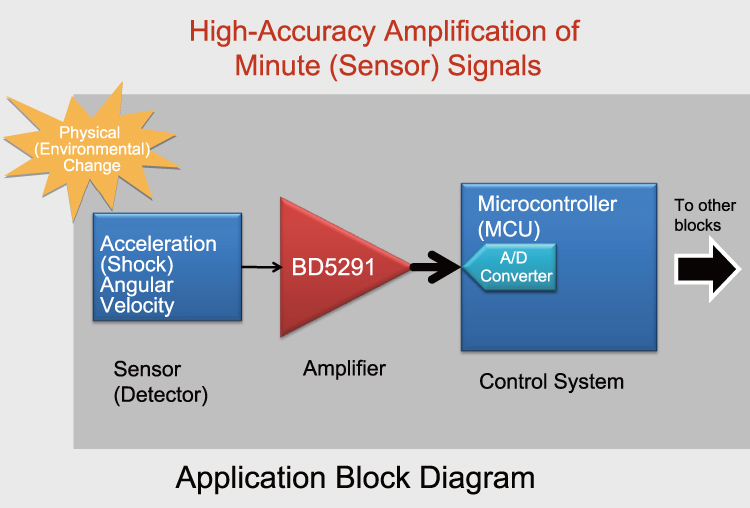
ROHM has recently announced the development of op-amps designed for motion sensor applications such as accelerometers (shock) and angular velocity detection. Recent years have seen a growing number of devices, such as smartphones, tablet PCs, and portable gaming systems, that incorporate sensors to detect acceleration, angular velocity, and other parameters. Sensors are devices often embedded in applications that convert physical changes to small electrical signals. To make use of these small signals, however, they must be amplified using sensor amps, which are positioned downstream of the sensor and require sensitive analog technology to ensure high-accuracy amplification.
Both the BD5291G and BD5291FVE utilize ROHM’s industry-leading analog technology, enabling input/output full-swing operation at only 1.7V. In addition, a high common-mode rejection ratio results in a small-signal processing accuracy 18x greater than conventional products.
Key Features
1. Low voltage operation with input full-swing
Low-voltage input/output full-swing operation is ideal for applications with low-voltage requirements.
2.High accuracy signal amplification
Offset voltage generated at the differential input
stage is reduced significantly, resulting in a high common-mode rejection ratio (70dB min). This makes it possible to amplify small signals (i.e. from sensors) with greater accuracy.
ROHM op-amps provide low voltage operation with input/output full-swing capability and high common-mode rejection ratio (conventionally difficult to achieve all 3), contributing to greater accuracy in small-signal applications such as sensor output. This makes them also well-suited for microphone amps, active filters, buffer amps, amplification circuits, and other applications utilizing opamps.
Following the increasing integration of digital and analog systems in power supplies is lower voltage operation. Unlike conventional input/output full-swing op-amps that operate from 1.8V, these products support 1.7V operation, providing sufficient margin against supply voltage fluctuations. In addition, common-mode rejection ratio is 70dB (min), compared to only 45dB (min) with comparable devices, making it possible to provide high-accuracy signal amplification. (CMRR is calculated by dividing the common-mode signal variation with the output voltage variation, with 45dB and 70dB roughly equivalent to 178x and 3,162x, respectively.)
Availability: Now (samples of BD5291G, OEM quantities of BD5291G, samples of smaller BD5291FVE, March 2013 (OEM quantities of BD5191FVE).