Scientists Fabricate High-Performance Large-Area Perovskite Submodules for Solar Cells
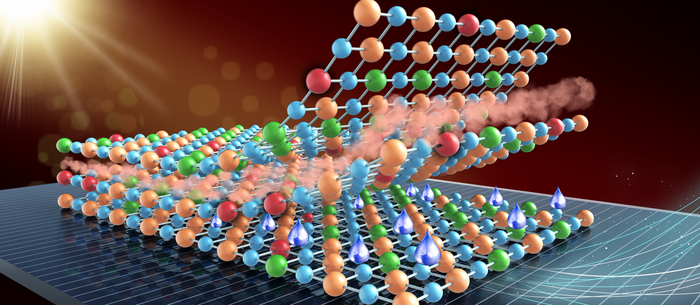
Perovskite solar cells (PSCs) are promising solar technologies. Although low-cost wet processing has shown advantages in small-area PSC fabrication, the preparation of uniform charge transport layers with thickness of several nanometers from solution for meter-sized large area products is still challenging.
Recently, a research group led by Prof. LIU Shengzhong from the Dalian Institute of Chemical Physics (DICP) of the Chinese Academy of Sciences (CAS) has developed a facile surface redox engineering (SRE) strategy for vacuum-deposited NiOx to match the slot-die-coated perovskite, and fabricated high-performance large-area perovskite submodules.
This work was published in Joule on July 21.
Inverted PSCs are potentially more valuable than their normal counterparts because the former have easily-mitigated hysteresis behavior and long-term durability. NiOx has been demonstrated as the hole transport materials for inverted PSCs. But for most vacuum-processed NiOx films, the relatively hydrophobic surface attenuates the adhesion of perovskite ink, making it challenging to deposit large-area perovskite films.
Moreover, the surface chemistry of NiOx is rather complex as a large number of high-oxidative-state Ni species and chemically reactive hydroxyls can decompose perovskites, leading to an interface energy barrier and noncapacitive hysteresis.
The SRE strategy not only eliminates the local de-wetting problem of perovskite ink, thus achieving uniform polycrystalline perovskite films at the decimeter level, but also imparts enhanced performance in electronic properties, stability, mechanical adhesion at the buried interface via modulating the NiOx surface features.
In this study, the researchers achieved high-performance PSCs with stability of thousands of hours under various stressed conditions and outstanding photovoltaic performance. The power conversion efficiencies of PSCs were 23.4% and 21.3% for rigid and flexible devices, respectively.
Furthermore, due to the scalability of SRE strategy to large-area configurations, they assembled perovskite submodules of area 156 × 156 mm2 with a remarkable efficiency of 18.6% along with negligible hysteresis and good stability.
"The SRE strategy provides a proof of concept for combining vacuum-fabricated charge transport layers with wet-processed perovskites and facilitates the stacking engineering of large-scale, uniform thin films for the development of efficient and stable perovskite modules," said Prof. LIU.
EurekAlert!, the online, global news service operated by AAAS, the science society.