A theoretical concept to realize quantum information processing has been developed by Professor Guido Burkard and his team of physicists at the University of Konstanz
The researchers have found ways to shield electric and magnetic noise for a short time. This will make it possible to use spins as memory for quantum computers, as the coherence time is extended and many thousand computer operations can be performed during this interval. The study was published in the current issue of the journal Physical Review Letters.
The technological vision of building a quantum computer does not only depend on computer and information science. New insights in theoretical physics, too, are decisive for progress in the practical implementation. Every computer or communication device contains information embedded in physical systems. "In the case of a quantum computer, we use spin qubits, for example, to realize information processing", explains Professor Guido Burkard, who carries out his research in cooperation with colleagues from Princeton University. The theoretical findings that led to the current publication were largely made by the lead author of the study, doctoral researcher Maximilian Russ from the University of Konstanz.
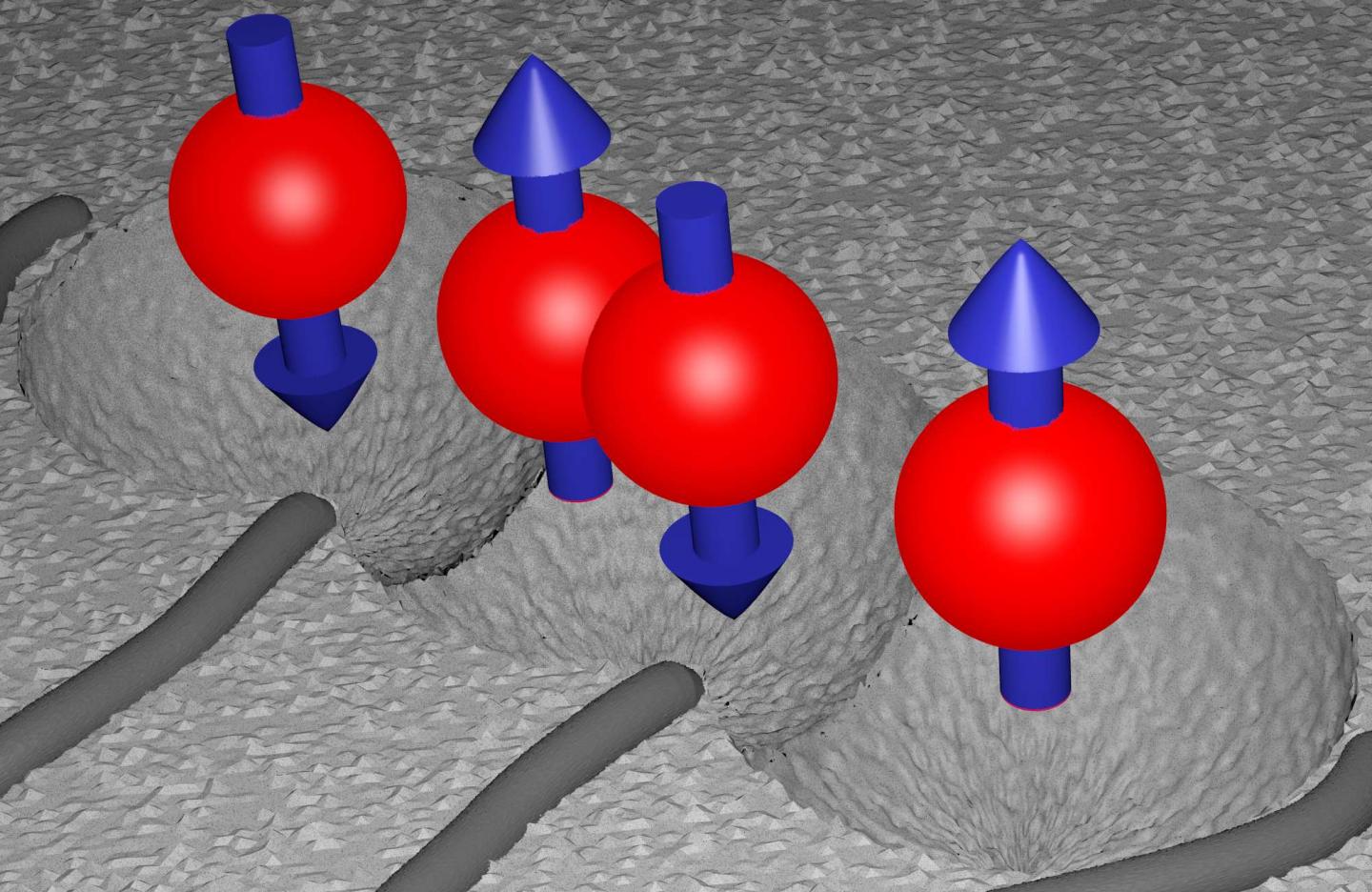
In the quest for the quantum computer, spin qubits and their magnetic properties are the centre of attention. To use spins as memory in quantum technology, they must be lined up, because otherwise they cannot be controlled specifically. "Usually magnets are controlled by magnetic fields - like a compass needle in the Earth's magnetic field', explains Guido Burkard. "In our case the particles are extremely small and the magnets very weak, which makes it really difficult to control them". The physicists meet this challenge with electric fields and a procedure in which several electrons, in this case four, form a quantum bit. Another problem they have to face is the electron spins, which are rather sensitive and fragile. Even in solid bodies of silicon they react to external interferences with electric or magnetic noise. The current study focuses on theoretical models and calculations of how the quantum bits can be shielded from this noise - an important contribution to basic research for a quantum computer: If this noise can be shielded for even the briefest of times, thousands of computer operations can be carried out in these fractions of a second - at least theoretically.
The next step for the physicists from Konstanz will now be to work with their experimental colleagues towards testing their theory in experiments. For the first time, four instead of three electrons will be used in these experiments, which could, e.g., be implemented by the research partners in Princeton. While the Konstanz-based physicists provide the theoretical basis, the collaboration partners in the US perform the experimental part. This research is not the only reason why Konstanz is now on the map for qubit research. This autumn, for example, Konstanz attracted the internationally leading scientific community in this field for the "4th School and Conference on Based Quantum Information Processing".
###
Key facts:
- Guido Burkard and his team of physicist at the University of Konstanz publish a theoretical concept to realize the processing of quantum information. The study was published in the current issue of the renowned journal Physical Review Letters.
-
Link to the original publication: https:/
/ DOI: https:/journals. aps. org/ prl/ accepted/ cf071Y52H8314171f2e801d42078646e42f9e53aa / doi. org/ 10. 1103/ PhysRevLett. 121. 177701 - In theoretical models and calculations the study shows how quantum bits can be shielded from magnetic and electronic noise. The new findings contribute to basic research for a quantum computer.
- Shielding the electric or magnetic noise results in an extended coherence time of spin qubits and thus provides the potential to carry out numerous computer operations.
- Konstanz research on spin qubits is carried out in collaboration with Princeton University. The new findings can now be tested in experiments.
-
Further links:
https:// www. uni-konstanz. de/ spinqubits
https:// theorie. physik. uni-konstanz. de/ burkard/
http://pettagroup.princeton. edu/
EurekAlert!, the online, global news service operated by AAAS, the science society: https://www.eurekalert.org/pub_releases/2018-10/uok-sqb102618.php