There is a rising demand for compact, efficient, and resilient power control systems, from utility-grade installations to consumer EV charging units
Power control is a critical aspect of the electrification trend, expanding demand for improvements, upgrades, and modernisation throughout infrastructures from solar and wind generators to points of use. Equipment targeting residential applications faces intense cost pressure, with demands for miniaturisation to allow unobtrusive and fashionable styles. On the other hand, industrial applications prioritise reliability and robust fault handling, while advancements that improve efficiency are wanted everywhere.
High-Current Switching
When it comes to handling high currents and voltages, electromechanical switches including contactors and relays are chosen for their high ratings and ability to safely isolate inactive loads. Contactors tend to have larger electromagnetic coils than relays as well as spring-loaded contacts for breaking the circuit and have been preferred in applications that involve controlling extremely high currents. Contactors have also tended to contain built-in weld detection that can protect the system if the main contacts become fused and fail to open when required. This is typically implemented with a set of auxiliary contacts that mirror the main contact structure.
With their auxiliary contact mechanism, higher coil rating, and spring loading, contactors tend to be physically larger than ordinary relays and usually have a lower maximum switching frequency. Interconnection typically relies on screw terminals, which require manual assembly. In today’s electrifying world, new applications like utility-grade photovoltaic generators and battery-energy storage systems, high-speed chargers and wallbox chargers for electric vehicles, are disrupting the old order. They contain large inverters that need the high DC- current switching capability and safety features of contactors while also demanding smaller size, and lower power consumption, in a device compatible with high-volume production techniques.Similar pressures apply to more traditional loads such as lighting, HVAC and FA, and uninterruptible power supplies (UPS), where power density is increasing and demand for smaller and faster-acting power switches becomes a necessity.
Relays Step Up
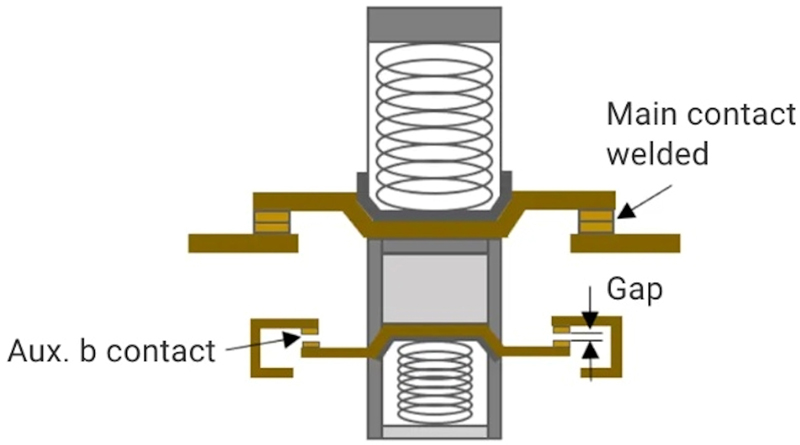
New developments among relays allow current ratings in the 50A-300A range, which lets these devices offer an alternative to contactors in many domestic, industrial, and utility-grade applications. The latest devices also feature weld detection with fault signalling thereby permitting comparable system protection. The auxiliary contact mechanism shown in figure 1 ensures safe insulation, with a withstand voltage of 2.5kV or minimum contact gap of 0.5mm, even after the coil is de-excited when the main contacts have a welding failure.
Click image to enlarge
Figure 2: High-current relays now incorporate auxiliary contacts for fault detection
Among the inherent advantages of relays, smaller component dimensions permit more compact and lower-profile enclosure sizes. This can be important for consumer markets that desire fashionable and minimalist styles, as well as industrial and utility applications that are challenged to provide extra capacity and support smart capabilities within existing space constraints. Contrasting the properties of a typical contactor with a comparable relay show that the relay can deliver more than 66% weight saving, over 60% height reduction, and 85% lower volume.
The relays’ smaller size and typically lower weight permit PCB mounting of high-power switches that can simplify and streamline equipment assembly. PCB-mounted components can be hand soldered or used with automated production processes that allow circuits to be assembled at high-speed using inline insertion equipment.
Soldering lets equipment vendors design-out traditional bulky and expensive components such as busbars and screw terminals that need to be manually fastened. In addition to permitting faster and more efficient assembly, soldered connections save human errors such as incomplete screw tightening or applying incorrect torque, permitting more consistent production quality.
On-Boarding
Moving established design practices and production flows away from traditional manually installed contactors to PCB-mount relay assemblies involves literally going back to the CAD drawing package to create a new circuit-board design. PCB design guidelines include ensuring adequate copper thickness to carry the intended current, noting that enlarging the terminal surface area can help boost heat dissipation. A heatsink or insulated metal substrate can help protect the board in applications that demand extremely high current. In addition, for high-capacity PCB relays, implementing a holding-voltage circuit or PWM drive circuit to minimise power consumption can effectively ease thermal management and can potentially reduce the drive power to 25%. Equipment vendors can recoup the investment to redesign their PCBs through greater saleability, delivering smaller, lightweight PCB-based assemblies that fulfil market desires.
To build new assemblies containing PCB-mount relays, the production area may also need to be reorganised to reduce or remove manual workstations and migrate production onto automated machinery for through-hole assembly. A comparison of production techniques suggests that soldered terminals can reduce the bill of materials (BOM) including busbars and screws by up to 35%, while assembly-process costs can be reduced by as much as 50%. The benefits gained through automated assembly become more significant as production is scaled to larger volumes.
OMRON’s high-current PCB-mount relays include the single-pole G9KA-1A1B-E, which can carry up to 1000 V / 300 A. the relays feature a specially designed mechanism that permits a contact gap of 4.0 mm, ensuring high performance with safety. The relays also contain a 30V/1A mirror contact structure for weld detection thereby meeting IEC 60947-4-1, the international standard for electromechanical contactors and starters including motor protective switching devices.
Under the Skin
While helping to reduce assembly size and ease manufacturing, the latest high-current PCB relays also enable greater product longevity and energy efficiency by significantly lowering contact resistance to minimise I2R losses and self-heating. In practice, self-heating is one of the most significant barriers as designers of high-current applications seek to downsize equipment dimensions and increase capacity. Heating increases according to the square of the current, driving internal temperature rise that can cause malfunctions and shorten the life of the PCB.
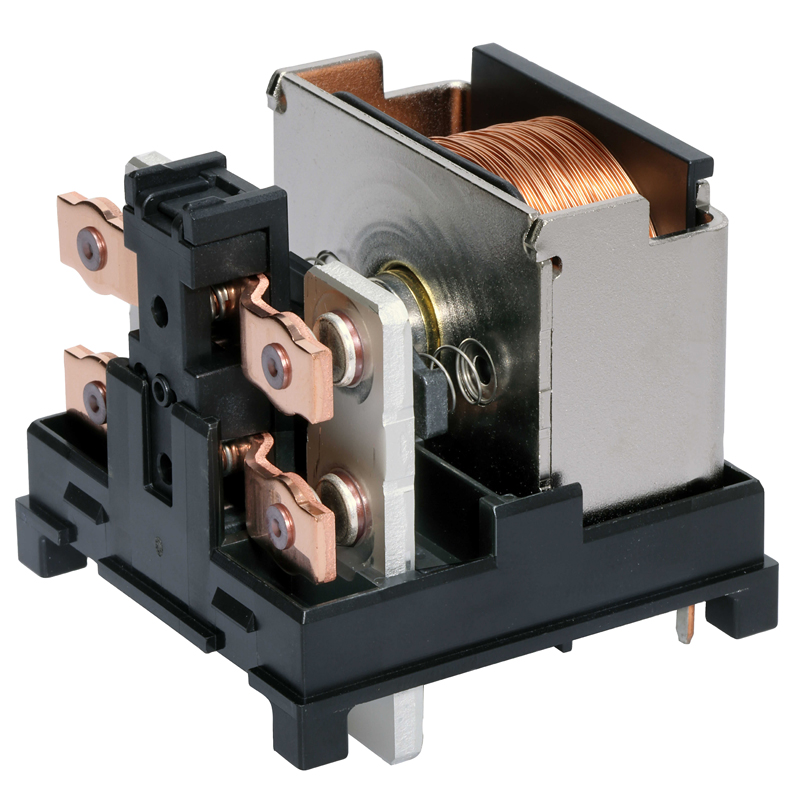
By incorporating a new double-break and twin-contact structure (figure 2), with a special contact material that has high electrical conductivity, the G9KA-1A1B-E achieve extremely low initial contact resistance of 0.2 mΩ. This contrasts with conventional high-capacity relays, which typically have initial contact resistance between 1 mΩ and 5 mΩ and can require fans and heat sinks for cooling. The new relays also have an optimized terminal structure that increases heat dissipation. Together, these features can reduce temperature rise by about 30% and thereby extend contact reliability. In addition, the coil power is lower, contributing further to increased efficiency.
Click image to enlarge
Figure 3: Today’s high-current PCB-mount relays are optimized for low contact resistance
Overall, while moving to PCB-mounted solutions requires upfront investment to redesign the PCB and optimise the manufacturing sequence, vendors can target long-term paybacks in cost, efficiency, and reliability.
Conclusion
Electromechanical contactors are historically accepted as the kings of high-current switching, covering a wide range of ratings up to hundreds of Amps. While their strengths also include auxiliary fault-detection contacts, there are disadvantages. Devices tend to have a large and heavy coil and contact mechanism, which adds bulk and limits switching frequency, while manual assembly methods slow production and allow scope for human error.
New demands arising from electrification are driving innovations in PCB relays that elevate current-handling capability and provide built-in fault detection, presenting a new option in the 50-300A range that permit more compact, reliable, efficient, and cost-effective power control.