SiC Diodes up Efficiency for High Frequency Applications
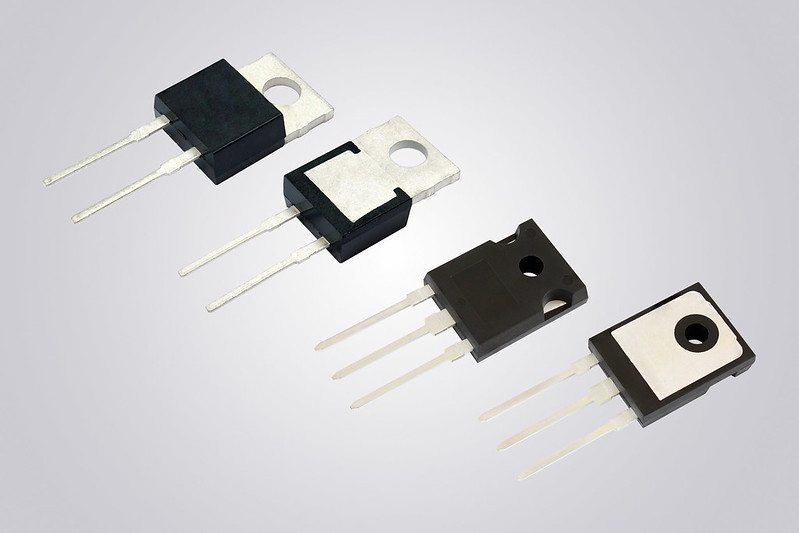
Featuring an MPS Design, 4 A to 40 A Devices Reduce Switching Losses and Effects From Temperature Variances
Vishay Intertechnology, Inc. introduced 10 new 650 V silicon carbide (SiC) Schottky diodes. Featuring a merged PIN Schottky (MPS) design, the Vishay Semiconductors devices are designed to increase the efficiency of high frequency applications by reducing switching losses regardless of the effects from temperature variances, allowing the diodes to operate at higher temperatures.
The MPS design of the diodes released today shields the electric field from the Schottky barrier to reduce leakage currents while increasing surge current capability via hole injection. Compared to pure silicon Schottky devices, the diodes handle the same level of current with only a slight increase in forward voltage drop while demonstrating a significantly higher degree of ruggedness.
The devices are intended for PFC and output rectification in flyback power supplies and LLC converters for servers, telecom equipment, UPS, and solar inverters, where they provide designers with increased flexibility in system optimization. The diodes are available with current ratings from 4 A to 40 A in the 2L TO-220AC and TO-247AD 3L packages and offer high temperature operation to +175 °C.
Samples and production quantities of the new SiC diodes are available now, with lead times of 10 weeks. Pricing for U.S. delivery only starts at $0.60 per piece.
For more on Vishay, visit their website.