NEWS: PRODUCT NEWS
Silicon Labs announces new single-chip relative-humidity and temperature sensor
11/08/2012
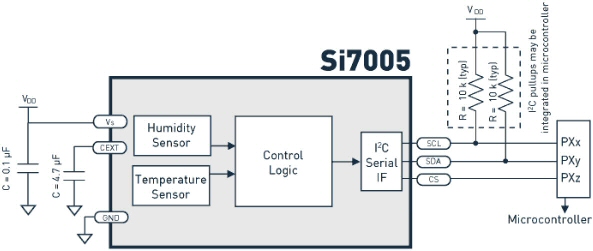
Click image to enlarge: Si7005 digital relative-humidity and temperature SoC block diagram
Silicon Labs' new Si7005 digital relative-humidity and temperature SoC combines a mixed-signal IC manufactured on standard CMOS with a proven technique of measuring humidity using a polymer dielectric film. The sensor is well suited for a wide range of automotive, industrial, and medical instrument applications that monitor or control relative humidity and temperature. The Si7005 device integrates sensing elements, an ADC, signal processing, non-volatile memory for calibration data, and an I2C interface in a monolithic CMOS IC. Features
- On-chip signal conditioning circuitry simplifies the design platform
- lower component count reduces design complexity
- smaller overall footprint
- Faster time to market
- Factory calibration for both relative-humidity and temperature sensing
- production line and field replaceable and interchangeable
- no recalibration or software changes required
- Optional factory-installed hydrophobic filter/cover for increased protection
- protects sensor before, during and after assembly, and throughout end product's lifetime
- measurement sensitivity unaffected by presence of filter
- eliminates material and labor costs
Related