Slave current-mode step-down phase extender for up to 300A has sub-milliohm DCR sensing
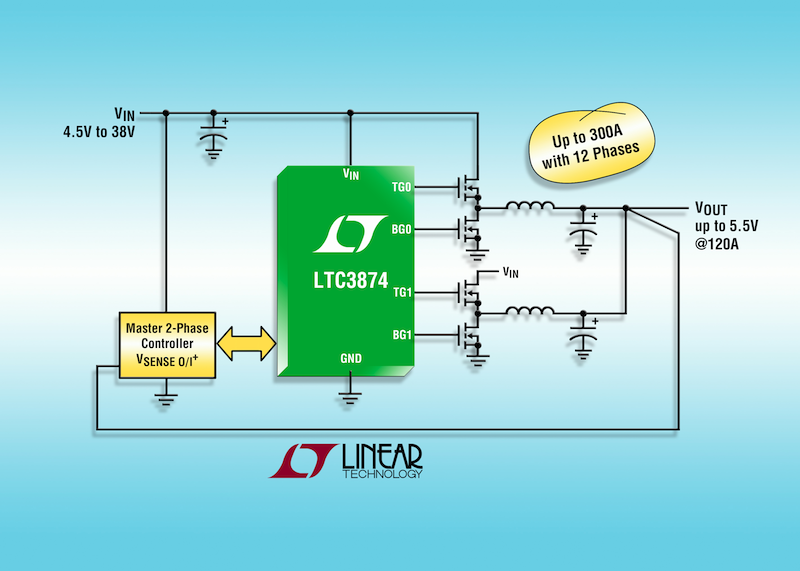
Linear Technology introduced the LTC3874, a dual-phase synchronous step-down slave controller that generates currents up to 300A when paired with a companion master controller by extending the phase count in multiphase applications. Compatible master controllers include the LTC3866, LTC3875 and LTC3774, which all have true current-mode control and enable the use of low (0.2 milliohms) DC resistance (DCR) power inductors without any sense resistor to maximize converter efficiency and increase power density.
The LTC3874 complements Linear Technology’s low DCR peak current mode controllers and provides all functions needed for multiphase slave designs, including accurate phase-to-phase current sharing even for dynamic loads. It operates over an input voltage range of 4.5V to 38V and produces a fixed output voltage up to 5.5V. Up to 12 phases can be paralleled and clocked out-of-phase to minimize filtering. Applications include power distribution, redundant (n+1) supplies, industrial systems, DSP and ASIC power.
The LTC3874 has a fixed operating frequency from 250kHz to 1MHz or it can be synchronized to an external clock. The powerful 1.1 Ohm onboard gate drivers minimize MOSFET switching losses. Precise programmable current sense threshold limits from 16mV to 72mV minimize power loss and accurately set the over-current trip point. Additional features include selectable continuous or discontinuous light load operation, programmable phase shift control and overvoltage protection.
The LTC3874 is available in a 28-lead 4mm x 5mm QFN package. The 1,000-piece price starts at $2.47 each.
 Caps PR.jpeg)


