SMD Bridge Rectifier Helps Save Manufacturing Assembly Costs
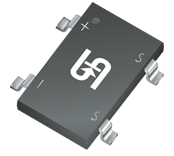
Taiwan Semiconductor Co., Ltd. (TSC) has announced the introduction of SMD bridge rectifier – TBS series.
SMD bridge rectifier – TBS series (TBS406, TBS408, TBS410, TBS606, TBS608, TBS610) is designed to optimize higher power application and prevents arcing problems through increased creepage distance with a wider pin distance (3.6 mm) between L to N. Designers benefit from a compact and thin profile package design with a profile height lower than 2 mm. TBS6 series by Taiwan Semiconductor has a surge current up to 150A (8.3ms half sine wave) and 400A (1ms half sine wave) - much higher than the surge current of the standard SMD bridge rectifiers on the market. The product family saves manufacturing assembly costs in comparison with DIP package and increases power density based on lower thermal resistance. Ideal for automated placement, TBS series by TSC is available with an IF of 4A and 6A and VRRM ranging between 600V up to 1,000V. All parts are UL certified (Recognized File # E-326854), RoHS compliant as well as halogen and antimony free.
Applications
§ Switching mode power supply (SMPS)
§ Adapters
§ TV
§ Monitor
More information including product specs and datasheets are available at: https://www.taiwansemi.com/en/news/newsletter/smd-bridge-rectifier-tbs-series