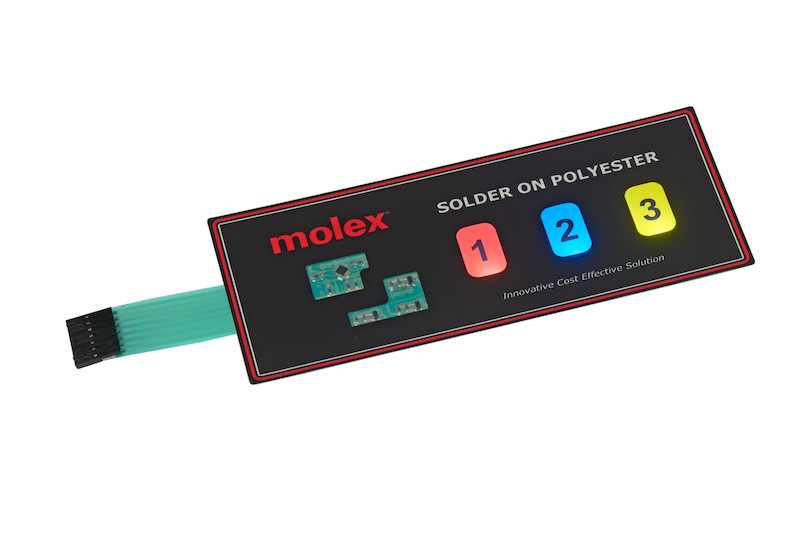
Molex has introduced Solder on Polyester Substrate, a flexible, economical alternative to rigid PCB and polyimide. Surface Mount (SMT) components, including fine-pitched integrated circuits (ICs) are attached with low-temperature solder and encapsulated on a polyester substrate. Custom designed products can be used for capacitive touch buttons, capacitive fluid level sensors and membrane switches in a broad range of consumer, medical and industrial applications.
“The ability to bond fine-pitch ICs to polyester film using traditional SMT processes can free up real estate on the controller PCB,” said Steve Fulton, engineering manager, Molex. “Before Molex developed this flexible circuit solution, ICs couldn’t be soldered to PET because the high-temperature process would damage the polyester. The alternative, conductive epoxy, can cause short circuits between closely spaced contacts, limiting component sizes and packages.”
By allowing smaller components with tighter pitches, the Solder on Polyester Substrate delivers higher yields and reduces costs. To ensure a robust connection, solder joints are protected by UV-cured encapsulant, enabling them to withstand vibration and mechanical shock. In addition, right-angle LEDs can be attached to enhance backlighting for user-interface applications. The flexible substrate is available in clear, translucent or white. Typical thicknesses are 0.13 and 0.18mm.
Solder on Polyester Substrate
Molex