Solid-State Relays Provide Industry-Leading Reliability
New portfolio can help make EVs safer while reducing solution size up to 90% and cost by as much as 50%
Building on more than two decades of experience developing new isolation manufacturing technologies and integrated circuits (ICs) for high-voltage systems, Texas Instruments (TI) introduced a new portfolio of solid-state relays, including automotive-qualified isolated drivers and switches, that deliver industry-leading reliability to help make electric vehicles (EVs) safer. The new isolated solid-state relays also provide the smallest solution size while reducing the bill-of-materials (BOM) cost of powertrain and 800-V battery-management systems.
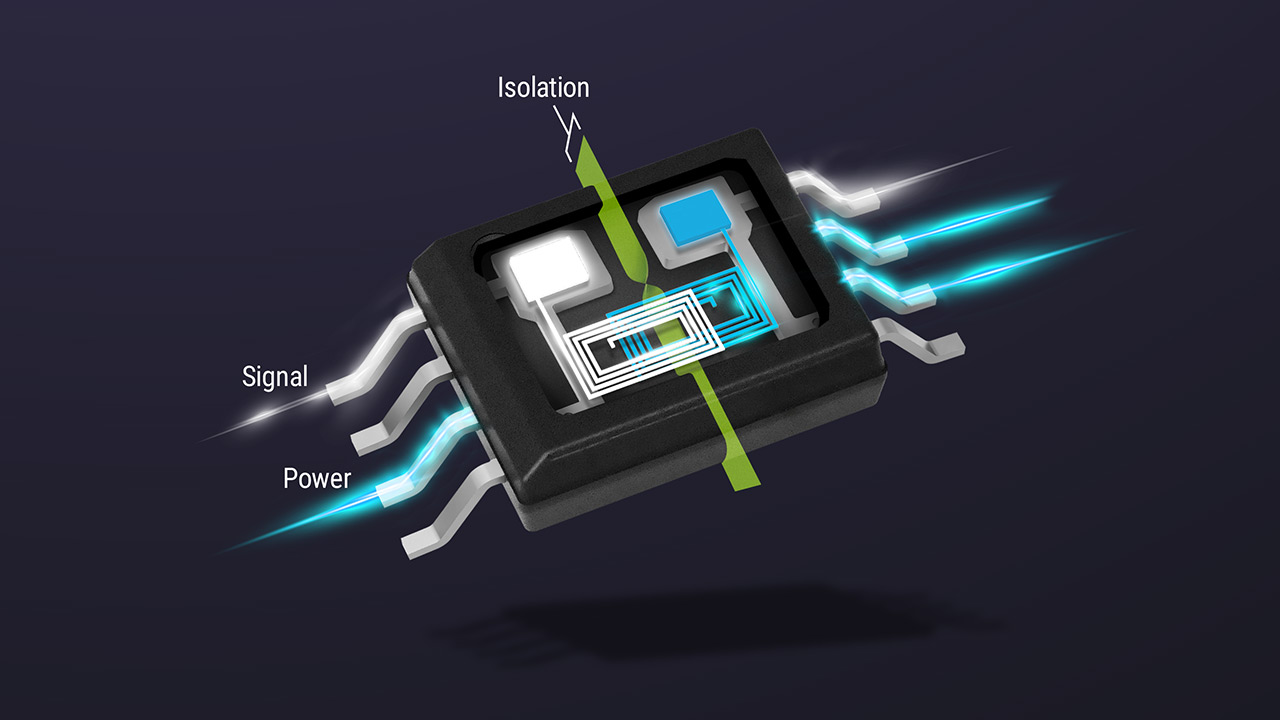
The TPSI3050-Q1 isolated switch driver with an integrated 10-V gate supply and the TPSI2140-Q1 1,400-V, 50-mA isolated switch both integrate power and signal isolation across a single barrier using a unique approach that improves reliability, while significantly reducing solution size and cost compared to existing electromechanical relays and solid-state photorelays. The devices are the first in a new solid-state relays portfolio that will also include ICs designed for high-voltage industrial applications.
Achieve higher system reliability with integrated isolation technology
The new solid-state relays can disconnect and connect loads through a single isolation barrier in microseconds – compared to milliseconds for electromechanical relays – to enable safer operation of high-voltage automotive systems. The TPSI3050-Q1, which offers reinforced isolation up to 5 kVRMS, also provides an operating lifetime that’s 10 times higher than electromechanical relays, which can degrade over time. Additionally, the TPSI2140-Q1 offers basic isolation up to 3.75 kVRMS, enabling it to achieve more than four times higher time-dependent dielectric breakdown reliability than solid-state photorelays.
Reduce system size and cost with integrated power and signal isolation
The solid-state relays integrate power and signal transfer in a single chip while also eliminating at least three components from their designs, significantly reducing solution size while cutting BOM costs by as much as 50%. The TPSI3050-Q1 reduces solution size up to 90% compared to mechanical relay solutions by integrating the functions of an isolated power supply, digital isolator and gate driver. The TPSI2140-Q1 reduces solution size by as much as 50% compared to traditional solid-state photorelay solutions by integrating a signal field-effect transistor and resistors, and eliminating the need for a reed relay.
Improve safety of 800-V EV battery-management systems
Designed for high-voltage measurements and insulation monitoring, the TPSI2140-Q1 works with a battery-pack monitor such as the BQ79631-Q1 to detect insulation faults in 800-V battery-management systems faster and with higher accuracy than solid-state photorelays. The TPSI2140-Q1 enables the use of <1-MΩ resistors and withstands over 300% more avalanche current than traditional photorelays to help enable safer human-system interaction.
Package, availability and pricing
The TPSI3050-Q1 and TPSI2140-Q1 are available in pre-production, 1,000-unit quantities only on TI.com at US$1.99 and US$2.75, respectively. Engineers can evaluate these products with the TPSI3050Q1EVM and TPSI2140Q1EVM evaluation modules, available on TI.com for US$49 each.
For more information, go here.