Würth Elektronik introduces its WL-OCPT dual-channel optocoupler phototransistor
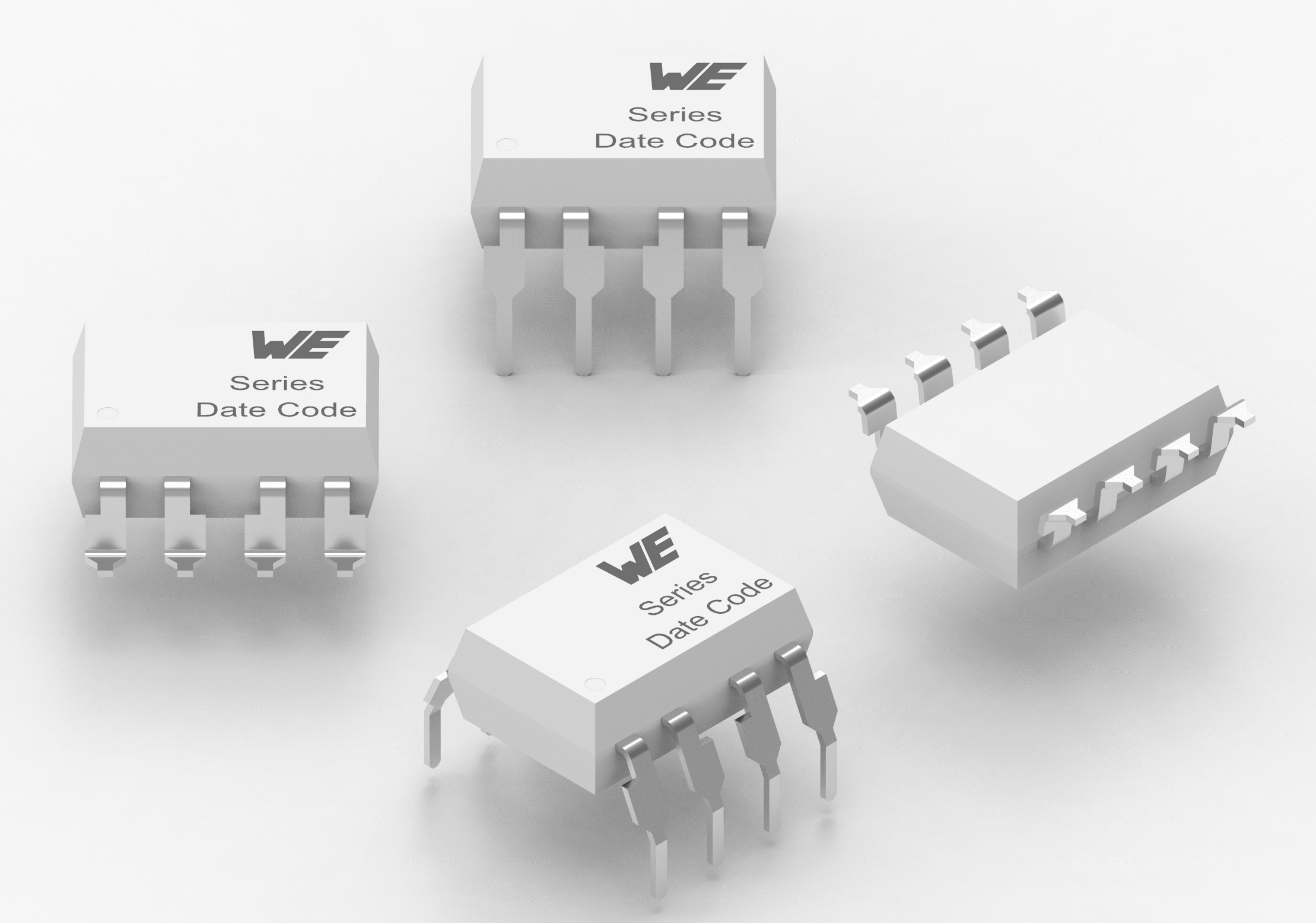
Würth Elektronik has expanded its WL-OCPT optocoupler product family with the DIP-8 design. Two-channel optocoupler phototransistors with eight pins are now available. This design contains two circuits inside a single component constructed from two input LEDs and two output phototransistors, therefore two separate circuits can be controlled with a single component. WL-OCPT features a stable current transfer ratio (CTR) over the entire operating temperature range (-55 to +110°C). The DIN-EN-60747-5-5-certified components have an insulation voltage of 5000 V, a collector-emitter voltage of 80 V, and a maximum forward current of 60 mA.
The Würth Elektronik optocouplers are suitable for optical and space-saving galvanic isolation in power supplies, chargers, computers, microprocessors, instruments, machines, ammeters or smart meters. Binning of the dual-channel WL-OCPT is in a CTR range of 130-400%, tested at an input current of 5 mA and a collector-emitter voltage of 5 V. Depending on the land pattern on the PCB, the DIP-8 optocoupler packages are available in standard, M, S and SL leadframe variants. The lead frames are made of copper thus guaranteeing the best solderability.
Like all other WL-OCPT series optocouplers, the DIP-8 variants are now available from stock without a minimum order quantity. Developers receive free samples on request.
Further information can be found here.