STMicroelectronics Reveals Ultra-Compact, Low-Power, NB-IoT Industrial Modules with GNSS Geo-Location Capability
STMicroelectronics’ ST87M01 ultra-compact and low-power modules combine highly reliable and robust NB-IoT data communication with accurate and resilient GNSS geo-location capability for IoT devices and assets. The fully programmable, certified LTE Cat NB2 NB-IoT industrial modules cover worldwide cellular frequency bands and integrate advanced security features.
As one of the first IoT cellular products worldwide offered in accordance with the latest 3GPP Release 15, the ST87M01 provides extended multi-regional LTE coverage. The integrated native GNSS receiver with multi-constellation access ensures enhanced and accurate localization along with optimized power savings features while operating during NB-IoT sleep time slots.
The module itself and all the internal ICs are entirely conceived, designed, and industrialized by ST, which ensures the complete control and management of the bill of materials and supply chain. This represents a unique market offer in terms of product quality, security and longevity. Moreover, the complete module has a diminutive 10.6mm x 12.8mm LGA footprint, making it ideal for applications where a small form factor clinches the design win.
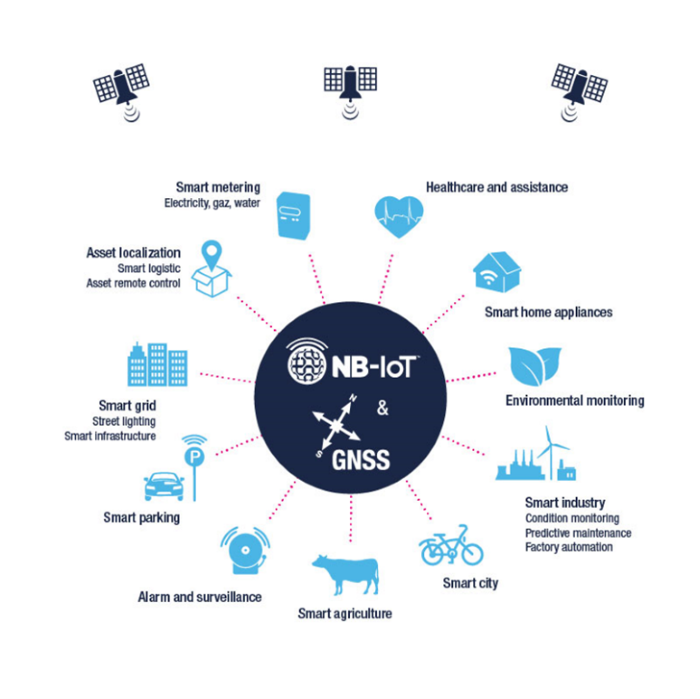
Qualified over the industrial temperature range (-40°C to +85℃), with ultra-low power consumption -- less than 2µA in low-power mode -- and transmit output power up to +23dBm, the ST87M01 targets wide-ranging IoT applications that require ultra-reliable Low Power Wide Area Network (LPWAN) connectivity. These include smart metering, smart grid, smart building, smart city and smart infrastructure applications, as well as industrial condition monitoring and factory automation, smart agriculture and environmental monitoring. It is also suited to tracking applications such as locating pets, children, and elders, safety monitoring for remote workers, asset tracking for equipment such as power tools, and general intelligent logistics.
The STM8701 offers flexibility for product developers, presenting a fully programmable IoT platform that lets users embed their own code directly in the module for simple applications. Alternatively, the module can be combined with a separate host microcontroller, permitting many more sophisticated use cases. A variety of protocol stacks is available to handle popular IoT use cases, including IPv6, TCP/UDP, CoAP/LWM2M, MQTT, HTTP/HTTPS and TLS/DTLS. Moreover, the ST87M01 is designed to support both standardized 3GPP AT commands, along with ST enhanced AT commands.
The modules also integrate a state-of-the-art ST4SIM embedded SIM (eSIM), certified according to the latest industry standards, such as the recent GSMA eSA (Security Assurance) certification, that further enhances asset miniaturization and security. There is also a state-of-the-art embedded secure element (eSE).
The ST87M01 combines readily with diverse technologies and products in ST’s portfolio, including microcontrollers, AI solutions, sensors, actuators, PMUs, converters, interfaces, memories, and other connectivity to enable next-generation IoT ecosystems.
The ST87M01 is in sampling now to major customers worldwide.
Please contact your ST sales office for pricing options and sample requests.
For more information, please visit here.