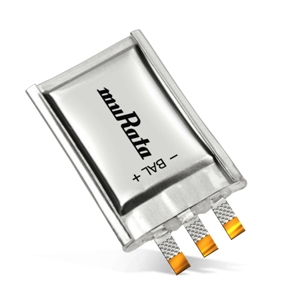
Supercapacitors present very slim profile
Offering high power in the form of higher allowable current than batteries or conventional electrical double-layer capacitors (EDLC), Murata's new DMF series of EDLC supercapacitors have an ultra-thin profile of 2.5mm. One of four series under the electrical double layer capacitor family that offers high power in the form of higher allowable current than batteries or conventional EDLCs, the DMF supercapacitors have low ESR from 40-60 mOhms, an operating temperature range from -30°C to 70°C, and capacitance values of 330mF and 470mF. Combining these double cell capacitors with various power devices provides a life-cycle of 100,000 cycles or more and enables the DMF capacitor to be used as a maintenance-free power storage element. The DMF capacitor has the highest level of power density throughout the industry, making it ideal for use as an auxiliary power supply for LED flash units, digital cameras and cell phones. Additional applications include peak load assist for GSM PA's, smart meters, compact motor starters and USB power bus. "Murata's high peak current supercapacitors offer one of the lowest profiles in the industry while providing low resistance, stable temperature characteristics and a wide operating temperature range," said Mark Waugh, Business Development Manager Murata Americas. "Murata continues to pack cutting edge components with features that customers need in a miniature package that allows for smaller and lighter end-user products." Murata's DMF supercapacitors