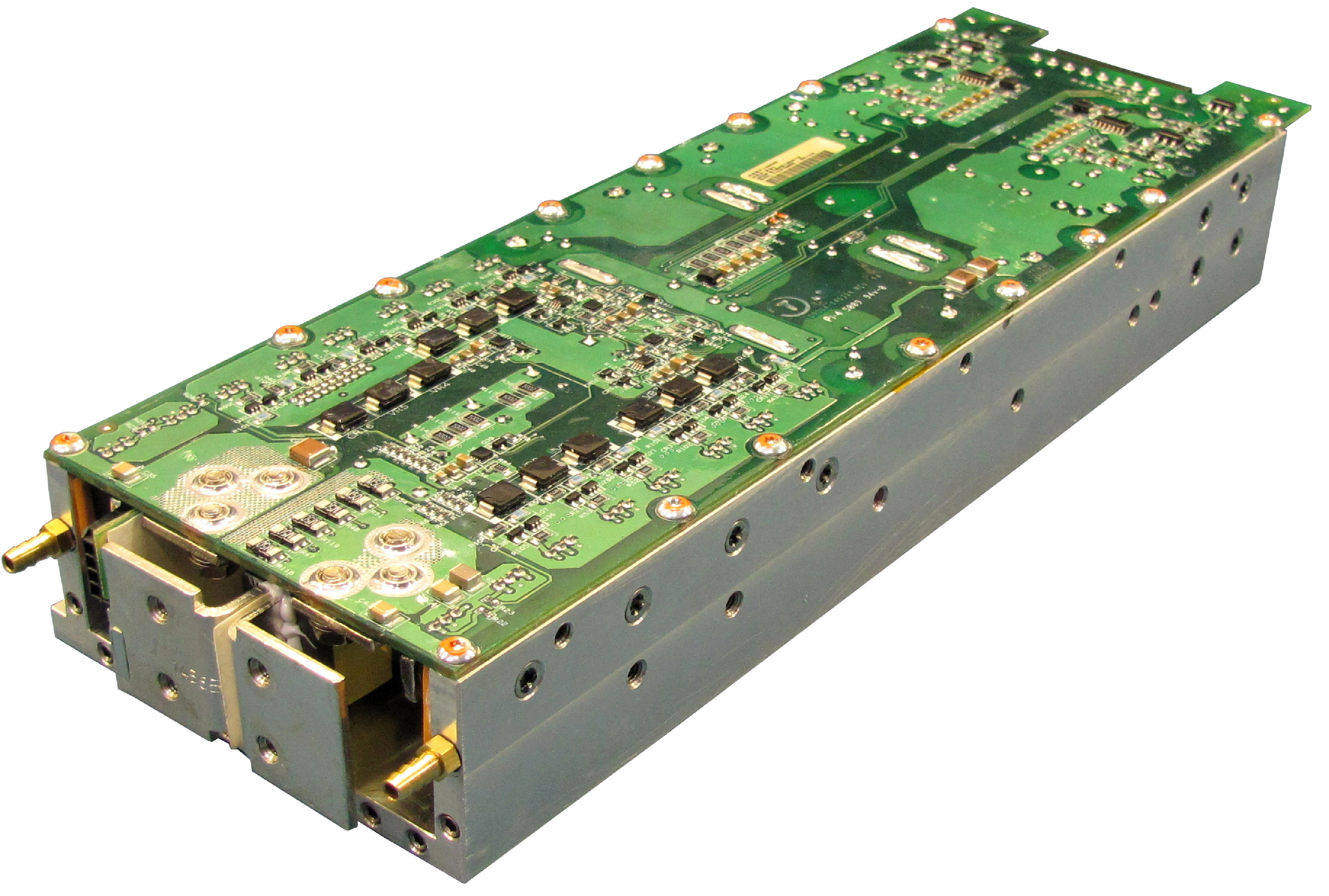
TDI has developed LiquaCore™ (patent pending) power management technology which employs liquid cooling from a modular and scalable architecture. The technology uses a cold plate to wrap the electronics with cooling liquid in a sealed package that enables efficient management of waste heat at very high power densities. The cooling liquid employed is either water or a mixture of water and ethylene glycol (anti-freeze). By using standard converter modules powered from a typical 370VDC bus, we can quickly configure a high power solution for virtually any application. As part of our power management technology, TDI Power has developed a 4.1kW, 28V liquid cooled DC-DC converter that boasts 93% efficiency and has an MTBF of more than 100,000 hours. With a power density exceeding 35w/in3, we can easily create a modular solution for higher power needs - up to 50kW or more. The module is ideally suited for harsh environment vehicular applications and can be configured with a customized outer chassis to meet virtually any available space claim. By utilizing common mechanical extrusions and mainstream components, the product is well suited for high volume manufacturing. Specifications: INPUT Voltage: 330—400VDC Operational, 370VDC Nominal, Over-voltage tested to 440VDC Peak Inrush Current: <45A Efficiency: 93% with 370VDC source, 50 to 100% load OUTPUT Voltage: 28V Power: 4,100W at Minimum specified coolant flow rate MECHANICAL Dimensions: H4.9 x W11.2 x D33.8 cm (H1.94 x W4.41 x D13.3") Weight: 2.8kg (6.2 lb) ENVIRONMENTAL SPECIFICATIONS Coolant Medium/Mixture: 60/40 Propylene or Ethylene Glycol/ Water Coolant Flow: 0.0208 to 0.0505 l/s (0.33 to 0.8 GPM) COMMUNICATION Communication Protocol: J1939 CAN BUS. (Optional) www.tdipower.com