T5838 and T5837 PDM microphones offer 68 dBA SNR consuming only 130 µA in always-on mode and 330 µA in high-performance mode
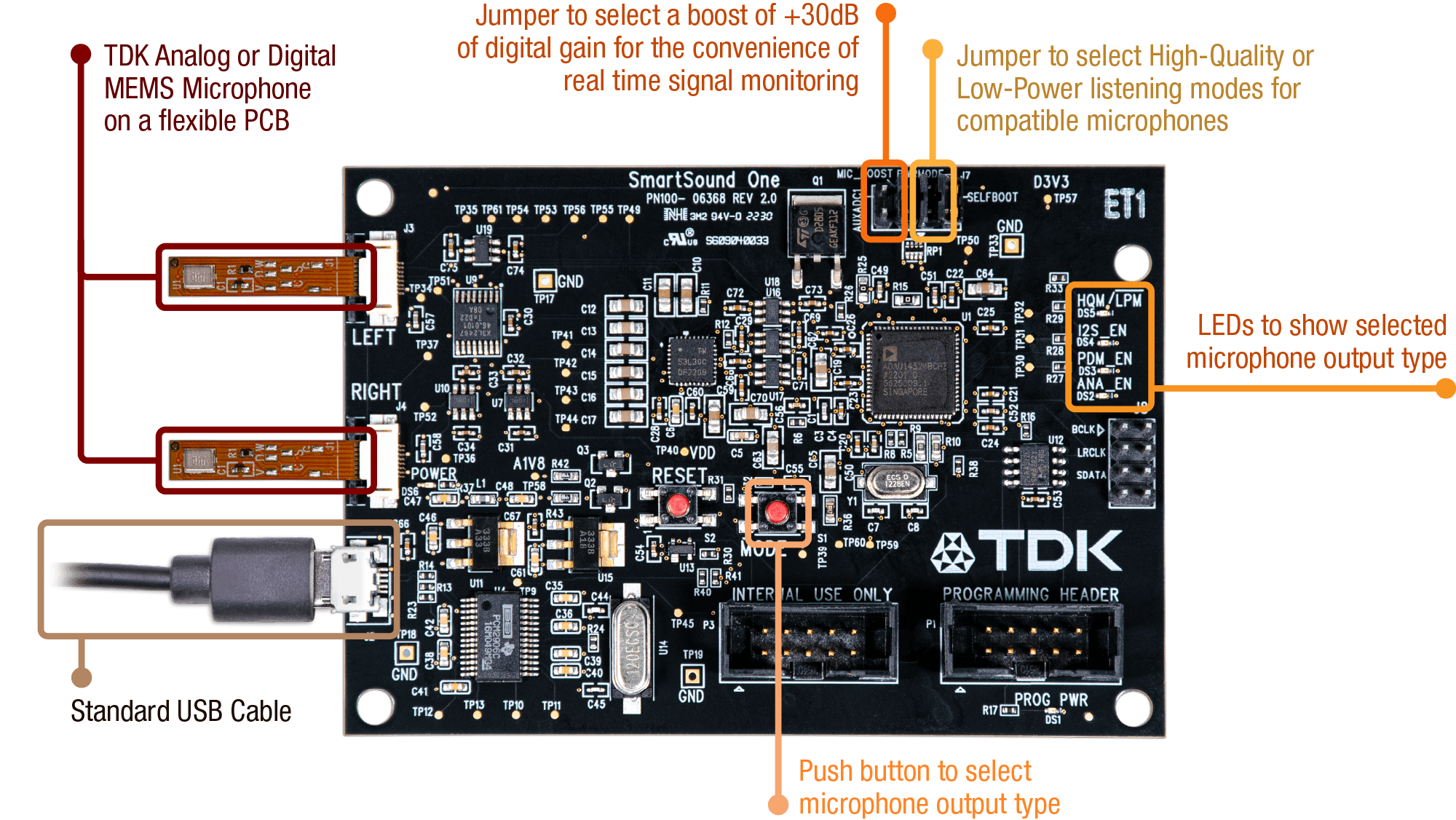
TDK Corporation announces availability of the InvenSense T5838 and T5837 MEMS microphones, and the SmartSound One Development Platform. These MEMS microphones push the boundaries of microphone acoustic performance, power efficiency, and advanced feature sets all in small package footprints. SmartSound One offers a solder-free, plug-and-play interface to evaluate and develop multiple types and configurations of microphones.
The T5837 and T5838 PDM MEMS microphones offer the world’s lowest power Pulse Density Modulation (PDM) multi-mode MEMS microphone with high acoustic overload point (AOP) of 133 dB SPL, high signal-to-noise ratio (SNR) 68 dBA, and wide dynamic range ideal for environments that shift from very quiet to very loud, such as far field voice pickup for smart speaker to ANC TWS applications.
-
T5837, a very low power wide dynamic range PDM digital microphone with industry standard features:
- Multiple modes of operation such as high quality, low-power (Always On), ultrasonic, and sleep mode
- High quality mode offers an SNR of 68 dBA while only consuming 310 µA of supply current at 1.8V
- Low-power (Always On) mode offers an SNR of 65.5 dBA while only consuming 120 µA of supply current at 1.8V
- Targeted to smartphones, TWS earbuds, tablets, cameras, Bluetooth headsets, smart speakers, notebook PCs, and security and surveillance market
-
T5838, a very low power wide dynamic range PDM digital microphone with new acoustic activity detect (AAD) features:
- Industry-leading acoustic performance, modes of operations, and low current draw as seen on the T5837
- Acoustic activity detect (AAD), a new ultra-low power edge processing feature where the microphone monitors the acoustic environment and when activity is detected, can wake up the main SoC or application processor out of a deep power down mode. This can maximize system battery life. The AAD is available with three modes of operation starting at just 20 µA, providing user programmability for various filters and thresholds to optimize performance for each application
- Targeted to smartphones, TWS earbuds, tablets, cameras, Bluetooth headsets, smart speakers, notebook PCs, security and surveillance markets, high-end voice activated remote controls, and voice-activated equipment
T5838 and T5837 are available in small 3.5 × 2.65 × 0.98 mm bottom port packaging. For more information visit here.